By Amy White
The Texas Catholic
Warm welcomes of “¡Qué gusto en verte de nuevo!” and “¿Cómo estás, todo bien?” greeted newcomers as they trickling into a common room on the St. Rita Catholic Community campus on Sept. 21. Spilling into their seats, those gathered soon turned their attention to Luisa Teresa Ravelo-Guedes, who had begun to sign herself “En el nombre del Padre, y del Hijo, y del Espíritu Santo.” The evening’s St. Rita Spanish Conversational Class had officially commenced.
Over the better part of two decades, Ravelo-Guedes, a parishioner of St. Rita, has faithfully led the Spanish Conversational Class, a ministry at the Dallas parish that gives students of any ability level — even the most novice learners — a supportive space to hone their conversational Spanish.
The ministry, Ravelo-Guedes said, originally emerged from the Diocese of Dallas’ partnership with the Diocese of Trujillo in Honduras. The partnership inspired several mission trips from North Texas to the Central American country, including a Bible Mission to St. Rita’s then-sister parish. Ravelo-Guedes, who was one of the 12 missionaries to participate in that trip, recalled the conversation that broke out among the missionaries on their plane ride back to Texas.
“They were like, ‘Yeah, we need to practice some Spanish; and once a year, that’s not enough,’” she said. “I’m looking at Father Mark (Seitz): ‘Well, maybe we can meet once a month at the parish and talk Spanish?’”
The group settled on meeting once a week instead.
“That,” Ravelo-Guedes said, “is how it all started.”
Quickly, interest in the Spanish class spread beyond the missionaries — and even beyond the bounds of St. Rita. Members of local communities who hoped to connect with Hispanic members of their churches, or who simply desired to engage in conversations with Spanish-speaking family members and friends, began attending.
“We had priests. We had nuns also,” said Ravelo-Guedes’ husband, Carlos Guedes, who assists with the Spanish Conversational Class ministry and, along with his wife, is a native of Venezuela. “We had deacons as well, many, and the Knights of Columbus.”
Students now meet on the parish campus each Monday evening during the academic year, with breaks for holidays, to practice their conversational Spanish as a community of learners.
“It kept going and kept going,” Ravelo-Guedes said, adding with a smile, “This is our 17th year. I cannot believe it!”
Connecting the Church
After opening each class in prayer, students and volunteers — grouped into tables based on their Spanish-speaking abilities — embark on the evening’s lessons together.
The classes, Ravelo-Guedes explained, may have students read a short story in Spanish, pulling from a handy list of relevant vocabulary words to do so; or may task the pupils with answering, in Spanish, questions about a printed picture on a handout. The point of the lessons is not to master each intricate rule of the Spanish language, she emphasized, but rather to gain confidence in speaking Spanish conversationally.
“What we won’t do: 14 different tenses in Spanish!” she said with a laugh. “It’s mainly just speaking, speaking, speaking.”
Guedes, who said he has only missed a single class in the ministry’s 17 years, concurred.
“There’s no homework. There’s no tests,” he said. “It’s the easiest way to have a conversational class in Spanish.”
During the classes, volunteers are present to answer questions, gently correct pronunciation, and lead the conversations that take place around the tables.
“At the beginning, everybody’s kind of tense and ‘I don’t want to talk,’” said volunteer Joe Havlik, a parishioner of Our Lady of Angels Catholic Parish in Allen, who said he drives 45 minutes to attend the classes, “but at the very end, I think a lot of people feel fairly comfortable.”
Sheree Havlik, who is married to Joe Havlik, said she has been attending the classes as a student for four or five years now alongside her husband. The practice she has received through the classes, she said, has helped her grow more confident when conversing in Spanish with native speakers.
“I am now venturing out to where I will actually try to speak Spanish with somebody else,” she said, “where before I knew so little and just didn’t have any confidence in my Spanish.”
The classes, the Our Lady of Angels parishioner hopes, will also help her to minister to the Hispanic women and men who come to her for help through Dawn of Mercy, her nonprofit ministry that supports those who have suffered sexual abuse or sexual assault.
“Doing this class,” she said, “I have a little more confidence now that I can at least try to speak with somebody.”
For Ravelo-Guedes, integration within the Church — across cultures, generations, and parishes — is the ultimate goal of the ministry. She hopes the class will continue to foster a deeper sense of community within the Church, helping Catholics transcend the barriers of language.
“My hope is to keep integrating,” Ravelo-Guedes said. “The Catholic Church is one. It’s universal. It’s for everybody.”
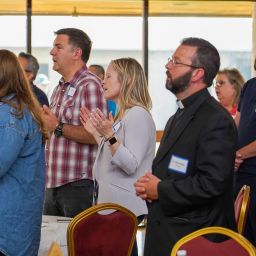
Cutline for featured image: Sheree Havlik, a parishioner of Our Lady of Angels Catholic Parish in Allen, smiles during a Spanish Conversational Class at St. Rita Catholic Community on Sept. 21. (AMY WHITE/The Texas Catholic)