By Michael Gresham
The Texas Catholic
The Diocese of Dallas is expanding its efforts to help Catholics with disabilities more fully participate in parish life, welcoming five additional parishes into its Community of Disciples initiative and broadening the ministry’s reach into predominantly Spanish-speaking and Vietnamese communities.
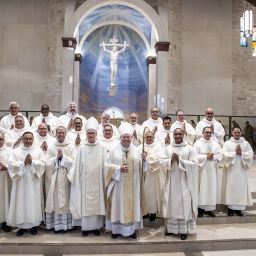
The second cohort of Community of Disciples officially began June 8 and includes St. Cecilia Catholic Parish, Corpus Christi Catholic Parish in Ferris, Holy Cross Catholic Parish, St. Michael the Archangel Catholic Parish in McKinney, and Sacred Heart of Jesus Christ Catholic Parish in Carrollton. The expansion builds on the initiative’s inaugural cohort of five parishes that began implementing disability ministry over the past year.
Funded in part through the Lilly Endowment Inc. Nurturing Children through Worship and Prayer Initiative, Community of Disciples helps persons with disabilities and their families grow in faith through fuller participation in eucharistic worship, prayer, and parish life.
Katie Groves, associate director of the Diocese of Dallas office for Persons with Disabilities and director of Community of Disciples, said the ministry equips parishes to create spaces where people with disabilities can “fully, consciously, and actively participate” in the life of the Church.
“The passion for this initiative and need in the Catholic community of Dallas is very present and only growing,” Groves said. “Parishes are excited to be a part of the initiative and eager to see the ministry grow.”
This year’s cohort also broadens the initiative’s reach across cultures and languages. Holy Cross and St. Cecilia, both located in southern Dallas, have large Spanish-speaking communities, while Sacred Heart of Jesus Christ serves the Vietnamese community.
“We are excited to further explore and collaborate to bring sensory friendly Mass and adaptive catechesis across language and culture with this new cohort, evermore illuminating the universality of our mission as the Community of Disciples and the mission of the Church,” Groves said.
Participating parishes receive leadership formation through summer and winter retreats, collaboration with consultants, the National Catholic Partnership on Disability, and the University of Dayton, adapted faith formation resources, parish toolkits, and ongoing support from diocesan staff as they discern how best to serve their communities.
For Groves, the work extends beyond accommodation.
“Inclusion invites people to the community who otherwise were not already there and not members of the community,” she said. “By virtue of our baptism, it is our right and duty to fully, consciously, and actively participate in the liturgy.”
Meaningful connections
The initiative’s first cohort is already offering examples of that vision in practice.
At St. Patrick, quarterly sensory friendly Masses have been celebrated since November 2025.
“We want everybody to know that they’re welcome, and that Jesus loves them, and we do too,” said Amy Vitek, the parish’s director of evangelization. “Each time, we have learned something new: what works, what needs to change, and how we can make the experience more prayerful and accessible for families.”
Vitek said pastor Father Charles Githinji intentionally celebrates the sensory friendly liturgies during a regularly scheduled parish Mass.
“He just really believes that we are one body of Christ,” she said. “We are not complete unless all members of the body are present and able to participate.”
Groves stressed that a key goal of the Community of Disciples initiative is to help people with disabilities become active participants in the full life of the Church. Vitek said St. Patrick is achieving that goal with its ministry leading parishioners with disabilities to serve in liturgical roles, families to return to Mass, and caregivers to find a renewed sense of belonging within the parish community.
At St. Joseph Catholic Parish in Richardson, parish leaders focused first on identifying broader accessibility needs, particularly among older parishioners experiencing hearing loss and mobility challenges.
“Many members of our aging community struggled with hearing the scriptures, homilies, prayers, the announcements before and after Mass, and being involved in parish events,” liturgy coordinator Stacey Gardner said. “This not only impacted their worship experiences, but it created barriers to meaningful, quality engagement and connection with the parish community.”
One of the parish’s significant improvements has been installing a hearing loop system, which wirelessly transmits sound directly to compatible hearing aids, cochlear implants, and other listening devices.
“Difficulty hearing during Mass can lead to isolation and reduced participation in worship,” Gardner said. “Accessibility is essential to ensuring that everyone is able to participate and be fully engaged.”
She said the initiative has strengthened participation throughout the parish and reinforced that meaningful accessibility often begins with simple, intentional steps.
“What has been most powerful is seeing the transformation it has brought,” Gardner said. “The ability to fully engage in Mass, hear the scriptures, participate in prayers — that is our success story.”
Groves said the long-term goal of Community of Disciples is for every family to be able to participate fully in parish life, receive faith formation and the sacraments, and find a welcoming community where everyone can share their gifts.
“This isn’t just a need for Catholics with disabilities but all baptized,” she said. “By providing opportunities to the parishioners we are currently in communication and contact with, we believe we will also be serving members of our community whose needs are not yet known to us.”
Cutline for featured image: Diocese of Dallas ministry leaders gather with representatives from the first and second Community of Disciples cohorts during a training seminar June 8 at the Montserrat Jesuit Retreat House in Lake Dallas. Community of Disciples is a diocesan initiative that helps parishes create welcoming, accessible communities where people with disabilities and their families can fully participate in worship, faith formation, and parish life. (MICHAEL GRESHAM/The Texas Catholic)