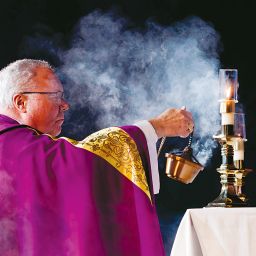
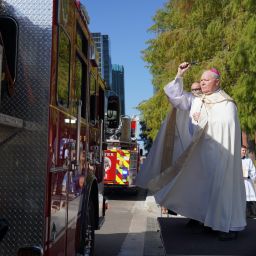
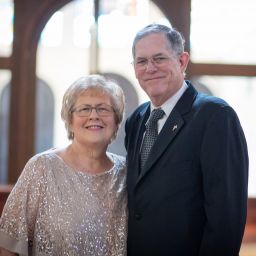
Bishop Edward J. Burns celebrated a Mass for the Rite of Admission to Candidacy for Holy Orders on Aug. 2 at Holy Trinity Seminary, recognizing seminarians Daniel Sanchez and Andrew Darling as candidates for the priesthood. The following is an excerpt of Bishop Burns’ homily from the Mass.
First of all, I would like to welcome Daniel and Andrew for this candidacy Mass along with your family members and your friends who are accompanying you along this journey toward priesthood.
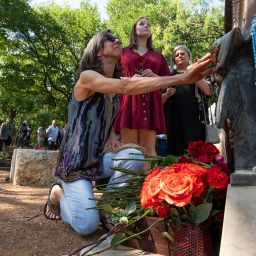
This past week, I had the privilege of making a pilgrimage to the shrine of Bl. Stanley Rother in Oklahoma City. I was accompanied by a lay leader within the diocese as well as two of our priests. It was especially meaningful, because we arrived on July 28, his feast day.
Many of you know his story.
Stanley Rother was an Oklahoma farm boy who became a priest for the Archdiocese of Oklahoma City. After his ordination, he was sent as a missionary to Guatemala, where he spent years serving the poor, celebrating the sacraments, translating Scripture into the local language, building schools, caring for families, and loving his people as a shepherd.
As violence spread throughout Guatemala in the late 1970s and early 1980s, priests, catechists, and lay leaders were being murdered. Friends urged Father Stanley to leave. Eventually, his bishop urged him to return home to Oklahoma for his own safety.
He did. His family was so happy to have him home. I understand that he even went to Mount St. Mary’s Seminary for retreat and to talk to a spiritual director.
But after prayer and discernment, he realized something profound.
His people still needed their shepherd. Using the words of Stanley Rother, there’s a book entitled, “The Shepherd Never Runs.”
He did not return to Guatemala because he wanted to die.
He returned because he knew how God was calling him to live.
That is a very different thing.
_________
Today’s Gospel begins with another moment of grief.
Jesus has just learned that John the Baptist has been murdered.
Imagine that.
The one who prepared the way for him has been executed.
Jesus withdraws to a deserted place.
Perhaps he wanted to pray.
Perhaps he wanted to grieve.
He simply wanted silence.
Yet, when he steps from the boat and sees the crowds, St. Matthew tells us something remarkable: “His heart was moved with pity for them.” I think that that is the exact kind of feeling that Stanley Rother had for his people — he was moved with pity for them.
In today’s Mass, we see that even in his own sorrow, Jesus’ heart is open wider for his people.
Instead of turning inward, Jesus turned toward his people.
He healed them. He taught them. And finally, he fed them.
That is the heart of Christ.
That is the heart every priest desires to have.
_________
When I was at Mount St. Mary’s Seminary in Emmitsburg, Maryland, Stanley Rother had graduated 20 years before I did.
When he was murdered in Guatemala in 1981, the news spread through the seminary very quickly.
One of our own had been killed.
Some time later, his parents and his sister, Sister Marita, came to the Mount for a memorial.
A number of us seminarians had the privilege of caring for them during their visit and offering hospitality. It was indeed a privilege, and to speak to the mother of a martyr is powerful.
I have never forgotten something his mother shared with me.
After Stanley was murdered, and as they were preparing his body to be returned to Oklahoma City, the people of Guatemala asked his parents if they could keep his heart.
Her first response was no.
She wanted to bring her son home.
She told me, “I just wanted my son home with me.”
But the people pleaded with her.
They said, “He loved us with his heart.”
Finally, she agreed.
Today, Bl. Stanley’s body rests in Oklahoma.
His heart remains in Guatemala. His heart was placed in the altar in the parish where he served in Guatemala, and it remains there today.
What a remarkable image.
His heart stayed with the people he loved.
_________
When I visited the shrine this past week, another memory came back to me.
On my way to the bishops’ meeting in Orlando this past June, I happened to run into my classmate from Mount St. Mary’s, Archbishop Paul Coakley of Oklahoma City.
Our names were always next to one another alphabetically —Burns and Coakley — so we spent years standing beside each other whenever we received ministries or advanced toward ordination, similar to this candidacy Mass.
I told him that a lay leader as well as two priests from Dallas and I were planning to visit the shrine on July 28.
He smiled and asked, “Ed, do you know that’s Stanley’s feast day?”
I had no idea.
He then invited me to join him for the noon Mass at the shrine.
When I was planning the trip, I discovered something else.
That very evening was the world premiere of a new documentary on Bl. Stanley’s life entitled, “The American Martyr: The Stanley Rother Story.”
There was a red carpet, interviews, a reception, the filmmakers, and afterward a discussion with those who had brought his story to the screen. Martin Sheen, the narrator, addressed everyone by video.
I could not help but think: The witness of this humble farm boy from Oklahoma continues to feed the Church.
_________
In today’s second reading, St. Paul asks one of the greatest questions in all of Scripture: “What will separate us from the love of Christ?”
Will persecution? Famine? Danger? The sword? War?
His answer is immediate.
Nothing.
Nothing can separate us from the love of Christ.
Stanley Rother believed those words.
The threats did not separate him from Christ.
The danger did not separate him from his people.
Fear did not separate him from his vocation.
Love brought him back.
Love kept him there.
Love carried him all the way to martyrdom.
_________
The first reading from Isaiah is also fulfilled in today’s Gospel.
“Come to the water.”
“Come and eat.”
Why spend your lives on what cannot satisfy?
Only God truly satisfies the human heart.
Jesus feeds five thousand people with five loaves and two fish.
Yet, the miracle points beyond itself.
It prepares us for another meal: the Eucharist.
Every Mass is the fulfillment of Isaiah’s invitation.
Come.
Without cost.
Receive the Bread of Life.
Be nourished by the One who alone satisfies.
_________
Bl. Stanley understood that. His ministry was never simply about providing food or building projects.
It was about leading people to Jesus Christ.
Yes, he cared for their physical needs.
But above all, he nourished them with the Word of God, with the sacraments, and with the Holy Eucharist.
That is what every priest is ordained to do.
To stand “in persona Christi” — in the person of Christ.
To bring Christ’s compassion and his mercy, his nourishment and his very heart.
_________
My brothers and sisters, perhaps the most beautiful part of Stanley Rother’s story is this: His heart never left Guatemala.
Because his heart had first become the heart of Christ.
And that is the invitation for every one of us.
Wherever God has placed us …in our marriage … in our family … in our parish … in our work … we are called to reflect the heart of Jesus Christ.
As I stood at the shrine of Bl. Stanley Rother this week, I found myself thinking about his heart — the heart that remained in Guatemala, because that was where he had poured out his life in love.
And it is important for us to realize that every church has the living heart of Jesus Christ present in the Holy Eucharist. It is from this altar that we receive his heart. It is from this altar that we learn how to love. And it is from this altar that Christ sends us into the world so that others may encounter his compassion through us.
May we leave this chapel today with hearts that look a little more like the heart of the Good Shepherd.
Amen.
Editor’s note: “American Martyr: The Stanley Rother Story” is scheduled to be released in theaters nationwide Aug. 25-27.
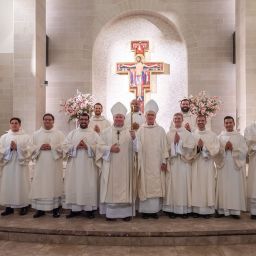
Cutline for featured image: Bishop Edward J. Burns, center, poses with, from left, Father Zachary Webb, Diocese of Dallas director of seminarians; seminarian Daniel Sanchez; seminarian Andrew Darling; and Father Mark Garrett, Diocese of Dallas director of vocations, after celebrating a Mass for the Rite of Admission to Candidacy for Holy Orders for Sanchez and Darling on Aug. 2 at Holy Trinity Seminary in Irving. (MICHAEL GRESHAM/The Texas Catholic)