By Carol Glatz
Catholic News Service
VATICAN CITY — Pope Leo XIV wanted his journey to Africa to highlight the serious injustices continuing there and propose a message of peace to a world marred by conflict and violations of international law.
“At the same time, the apostolic journey gave people in Africa a chance to make their voices heard and to express the joy of being God’s people,” he said.
As had been customary by his predecessors, Pope Leo used his first general audience after his April 13-23 trip to four nations in Africa to tell people about the purpose of his visit and what struck him most about his travels.
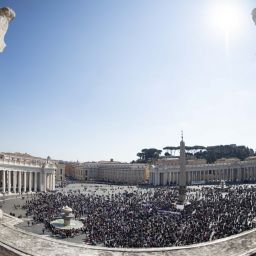
Addressing thousands of people in St. Peter’s Square April 29, Pope Leo said in English that his time there “was meant to offer the world a message of peace at a moment marked by conflicts and frequent violations of international law.”
“Along with the call for peace, I also denounced the grave injustices that exist in those countries that are so rich in natural resources, urging the international community to overcome neo-colonial attitudes and engage in authentic collaboration,” he said.
On his journey, the pope visited Algeria, Cameroon, Angola, and Equatorial Guinea.
“From the very beginning of my pontificate, I have thought about a journey in Africa,” he said in his main address in Italian. “I thank the Lord for granting me the opportunity to undertake it, as shepherd, to meet and encourage the people of God.”
In Algeria, a predominantly Muslim country, the pope said he wanted to “show the world that it is possible to live together as brothers and sisters, even of different religions, when we recognize ourselves as children of the same merciful Father.”
The northern African country is also the birthplace of his “spiritual father,” St. Augustine, and by “revisiting the roots of my spiritual identity,” it offered a way to highlight his legacy, he said. “He is a master in the search for God and for truth — a testimony that is more important than ever today for Christians and for every person.”
The other three countries were predominantly Christian, he said, and “I, therefore, found myself immersed in an atmosphere of celebration of the faith.”
It was also a bit similar to “what happened to Jesus with the crowds in Galilee: He saw them thirsting and hungry for justice and proclaimed to them: ‘Blessed are the poor; blessed are the meek; blessed are the peacemakers,'” the pope said, “and, recognizing their faith, (Jesus) said, ‘You are the salt of the earth and the light of the world.'”
In Cameroon, he told the crowds in St. Peter’s Square, he reinforced the call to work together for reconciliation and peace.
Like the rest of the continent, Cameroon is rich in natural and human resources, he said, but there needs to be: “a fair distribution of wealth”; more opportunities for young people; an end to “endemic corruption”; the promotion of integral and sustainable development; and a stop to “the various forms of neo-colonialism with far-sighted international cooperation.”
In Equatorial Guinea, he said, the people “have weathered the vicissitudes of their history” and “renewed with great enthusiasm their determination to walk together towards a future of hope.”
“I cannot forget what happened in the prison in Bata,” he said, saying he “had never seen anything like it.”
“The prisoners sang at the top of their voices a song of thanksgiving to God and to the pope, asking him to pray ‘for their sins and their freedom,'” and then “they prayed the ‘Our Father’ with me in the pouring rain — a genuine sign of the Kingdom of God!”
Remarking on Angola overcoming its troubled period of civil war, the pope said, “God has guided and purified the Church, increasingly converting her in the service of the Gospel, human promotion, reconciliation, and peace — a free Church for a free people!”
Seeing the joy and unity of the different generations and vocations of the Catholic faithful, the pope said he witnessed “the foundation of a hope that withstands the disappointments caused by ideologies and the empty promises of the powerful.”
“This hope demands concrete commitment, and the Church has the responsibility, with the witness and courageous proclamation of the Word of God, to recognize the rights of all and to promote their actual respect,” he added.
Whenever a pope visits a country, it is a chance for the people to have their voices be heard and for Catholics to “express the joy of being God’s people and the hope for a better future, of dignity for each and every one,” he said. “I am happy to have given them this opportunity, and at the same time I thank the Lord for what they have given me, an inestimable treasure for my heart and my ministry.”
Cutline for featured image: Pope Leo XIV rides in his popemobile, which passes by a group of traditional flag twirlers, during his general audience in St. Peter’s Square at the Vatican April 29. (CNS photo/Vatican Media)