By Gina Christian
OSV News
Two prominent Catholic cardinals have expressed their profound concern and sorrow over a recently announced decision by the Society of St. Pius X — which rejects the authority of the Second Vatican Council — to ordain bishops this summer without papal approval.
“The only solution possible in conscience before God is for the Society of St. Pius X … to recognize our Holy Father Pope Leo XIV as the legitimate Pope not only in theory but also in practice, and to submit to his teaching authority and his primacy of jurisdiction without preconditions,” wrote Cardinal Gerhard Müller, former prefect of what is now the Vatican’s Dicastery for the Doctrine of the Faith, in a Feb. 21 piece published by the independent Austrian Catholic newsmagazine Kath.net.
“Can one who abandons the Chair of Peter still claim to be within the Church of Christ?” asked Cardinal Robert Sarah, prefect emeritus of the Dicastery for Divine Worship and the Discipline of the Sacraments, in a statement published in part Feb. 22 in the French weekly Le Journal du Dimanche.
Citing the cardinal’s permission, Vatican journalist Diane Montagna provided the full text of Cardinal Sarah’s plea, translated into English from the original French, in a Feb. 23 post on her Substack page.
The cardinals’ statements followed a Feb. 18 letter from SSPX superior Father Davide Pagliarani declining further dialogue with the Vatican on terms proposed by the latter.
Father Pagliarani also advised the Vatican that his order — founded in 1969 by Archbishop Marcel Lefebvre — would proceed with planned episcopal ordinations on July 1.
“We both know in advance that we cannot agree doctrinally, particularly regarding the fundamental orientations adopted since the Second Vatican Council,” Father Pagliarani wrote in the letter to Cardinal Víctor Manuel Fernández, prefect of the Vatican’s Dicastery for the Doctrine of the Faith.
The dicastery, which had sought to resume talks with SPPX, had warned that proceeding with the consecrations “would imply a decisive rupture of ecclesial communion (schism) with grave consequences for the Fraternity as a whole.”
Along with the letter, made public Feb. 19, SSPX published a statement on its website arguing that it does not believe it is acting in schism.
The long-running strain between SSPX and the Vatican, which St. John Paul II, Pope Benedict XVI, and Pope Francis sought to address, has left the society in “irregular” canonical status, while dampening Pope Leo XIV’s efforts to further Christian unity.
In their respective statements, Cardinal Müller and Cardinal Sarah urged Church unity, even as they respectively acknowledged frustrations with certain liturgical abuses and deviations from Church teaching among some clergy.
However, both firmly asserted that SSPX’s defiance of papal authority — while claiming to preserve Church tradition — was theologically untenable and schismatic.
“I know only too well how the Deposit of Faith is sometimes scorned even by those who have the mission to defend it,” wrote Cardinal Sarah. “But the surest protection against error and heresy remains our supernatural and canonical attachment to the Successor of Peter.”
He added, “We are told that this decision to disobey the law of the Church is motivated by the supreme law of the salvation of souls. … But salvation is Christ, and He gives Himself only within the Church. How can one claim to lead souls to salvation by paths other than those He Himself has indicated to us?”
“Rightly so, not only the Society of St. Pius X, but a large part of the Catholic population laments that under the guise of Church renewal — with the process of self-secularization — great uncertainties regarding dogmatic questions and even heresies have infiltrated the Church,” wrote Cardinal Müller, who also pointed to Germany’s controversial Synodal Way, which he said “is indeed about introducing heretical doctrines.”
“But,” Cardinal Müller said, “even in the 2000-year history of the Church, heresies from Arianism to Modernism were only overcome by those who remained in the Church and did not turn away from the Pope.”
The cardinals both cited Scripture, the Second Vatican Council, Church history, and the witness of several saints in their statements, urging the SSPX to reject schism and return to communion with Rome.
Both Cardinal Müller and Cardinal Sarah in particular referenced St. Catherine of Siena, a 14th-century Dominican tertiary and mystic who challenged Pope Gregory XI, Pope Urban VI, and other papal officials to foster Church unity and reform.
Cardinal Sarah observed that the saint, “who did not hesitate to rebuke cardinals and even the Pope, declares: ‘Always obey the shepherd of the Church, for he is the guide whom Christ has established to lead souls to Himself.'”
“The good of souls can never be served by deliberate disobedience, for the good of souls is a supernatural reality,” Cardinal Sarah said. “Let us not reduce salvation to a worldly game of media pressure.”
“If the Society of St. Pius X is to have a positive impact on church history, it cannot fight for the true faith from a distance, from the outside, against the Church united with the Pope, but only within the Church, with the Pope and all orthodox bishops, theologians, and faithful,” Cardinal Müller said. “Otherwise, its protest remains ineffective and is even mockingly misused by heretical groups to accuse orthodox Catholics of sterile traditionalism and narrow-minded fundamentalism.”
“The best way to defend the faith, Tradition, and the authentic liturgy will always be to follow the obedient Christ,” Cardinal Sarah said. “Christ will never command us to break the unity of the Church. As Saint John Chrysostom says: ‘The unity of the Church, preserved by the Holy Spirit, is more precious than all the riches of this world.'”
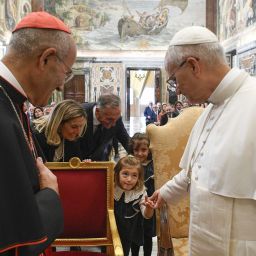
Cutline for featured image: German Cardinal Gerhard Müller, former prefect of the then-Congregation for the Doctrine of the Faith, is pictured in a Jan. 14, 2023, photo. (CNS photo/Paul Haring)