By Gretchen R. Crowe
OSV News
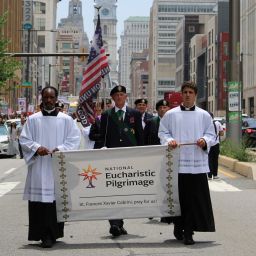
BRUNSWICK, Ga. — As the National Eucharistic Pilgrimage continued to make its way up the East Coast, it took a day to encounter Friar Pedro de Corpa and Companions, the five Franciscan friars — also known as the Georgia Martyrs — who will be beatified Oct. 31 in Savannah, Georgia.
On May 26, the perpetual pilgrims paused in Brunswick to learn more about the 1597 martyrdom of five Franciscan friars on what is now known as the coast of Georgia, via historical presentations and on-site exploration.
Two years before the martyrdoms, in 1595, six friars had arrived — without any Spanish military presence — to minister to the native Guale people. When one of the Guale sought to take a second wife and was refused by Friar de Corpa, there was an uprising that destroyed the peace, and Friar de Corpa and four other friars were brutally killed. The sixth, Friar Francisco de Ávila, lived to tell the tale — but also extended mercy to his attackers, refusing to testify against them at an ensuing trial because he knew doing so would bring about their deaths.
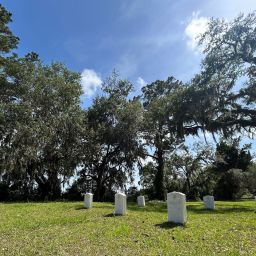
Michael Putnam, site manager at Fort King George State Historical Site, one of two confirmed sites of Spanish missions dating back to the 16th and 17th centuries, believes one of the five martyrs — Friar Francisco de Veráscola — was martyred on the land that is now the present-day historical site.
“Friar Verascola was coming up by a handheld boat, probably with a group of folks,” Putnam said, standing next to the Georgia marsh on what is called the “Lower Bluff.”
“He would have tried to get as close to home as possible — so somewhere in this area, most likely, as the bluff naturally slopes and the river comes up a little bit closer, beaching his boat and getting out,” Putnam continued, “and somewhere between that spot and the final mission spot, which is probably where he lived, would have been his final resting place.”
In addition to being the site of a Spanish mission (the other is located on the privately owned St. Catherines Island to the north), Fort King George also provides an idea of how the Guale people of the time lived.
“We have a lot of artifacts that were found here on this bluff from the Guale — a lot of ceramics,” Putnam said. Also on the site is a reconstructed Guale home and, in the museum, a portion of a Franciscan rosary, made from jet, a semi-precious stone formed from fossilized wood.
The intersection of the National Eucharistic Pilgrimage with the work of the Franciscan missionaries, though approximately 500 years apart, shows how the Church’s work is a constant, said Father Pablo Migone, vicar for mission advancement for the Diocese of Savannah and pastor of two area churches.
“It’s a reminder of how the Church has, over the centuries, continued to send out missionaries to all peoples, to all nations, to faraway places,” said Father Migone, one of the driving forces behind the effort to recognize the Georgia martyrs formally as saints of the Church. “That is something we have done from the very beginning from the words of Jesus to the Apostles.”
“The Church has done that, does that today, and the story of these friars is precisely a story of that happening in the late 1500s when there was this enormous evangelization effort coming out of Spain to the New World,” Father Migone said.
Learning about the Georgia Martyrs “really is a tangible opportunity to experience the communion of the saints and to be reminded that this is our universal call,” Mary Carmen Zakrajsek, one of the nine perpetual pilgrims with the National Eucharistic Pilgrimage, told OSV News. “Not all of us are going to get to be martyrs, but I think we will definitely feel their intercession.”
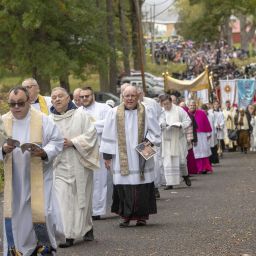
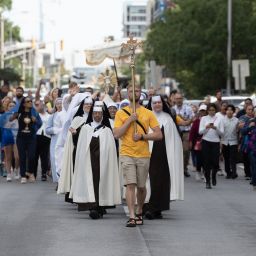
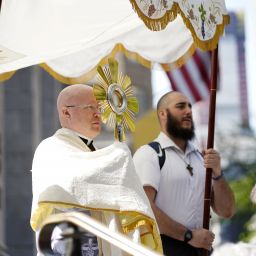
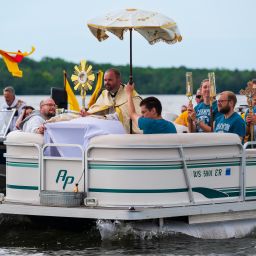
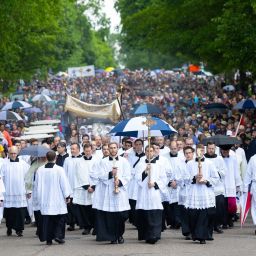
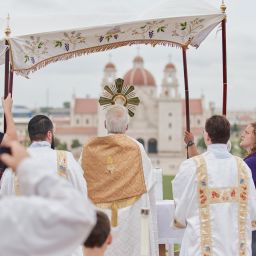
“I’m really excited and happy that we can maybe shine a little bit of a spotlight on the Georgia Martyrs and really get people familiar with them leading up to” their Oct. 31 beatification, said Zach Dotson, one of the pilgrims who participated in the Eucharistic procession from Fort King George to nearby Nativity of Our Lady Church in Darien, Georgia. “I think it’s a great reminder for all of us to rely on the saints and, you know, a good reminder that the seeds of the Church were watered by the blood of the martyrs.”
Cutline for featured image: A monument to Pedro de Corpa and Companions, also known as the Georgia Martyrs, stands outside of Nativity of Our Lady Church in Darien, Ga., May 26. The monument, sculpted by Timothy Schmalz, was blessed in 2021. (OSV News photo/Gretchen R. Crowe)