By Michael Gresham
Special to The Texas Catholic
IRVING — Holy Trinity Seminary celebrated its annual Spes Gregis Benefit, or “Hope of the Flock,” Oct. 24, marking six decades of forming priests while looking ahead to the future.
The seminary is at full capacity this year, with 84 seminarians representing 13 dioceses across the United States.
During the celebration, Bishop Edward J. Burns spoke about the growth of the Diocese of Dallas and the increasing need for priests.
“We find ourselves at another extraordinary moment. The Diocese of Dallas is growing at a remarkable rate,” Bishop Burns said. “We are approaching 1.4 million Catholics; our parishes are growing; our Catholic communities are expanding; and the need for good, holy, faithful priests has never been greater.”
The bishop also recognized that the seminary’s influence reaches well beyond North Texas.
“What takes place within these walls does not simply affect the Diocese of Dallas,” Bishop Burns said. “What happens here impacts the Church throughout our country.”
Accommodating growth will require additional space and improvements to existing facilities. Plans include the construction of a new building dedicated to the propaedeutic stage of priestly formation, when men beginning their seminary journey establish a foundation of prayer, discernment, fraternity, and spiritual growth. The project also includes a comprehensive renovation of the current facilities.
Bishop Burns said the investment goes well beyond improving the campus.
“We are investing in vocations. We are investing in the priesthood and in the sacraments,” he said. “We are investing in the future of the Catholic Church, because these buildings will ultimately serve something far greater than themselves.”
Father Vincent Anyama, rector of Holy Trinity Seminary, echoed the bishop’s assessment, saying “it is time to take a hard look at the future of this thriving seminary and boldly explore how to be good stewards of its legacy.”
“One thing is evident: There is a need for us to expand our campus and upgrade the existing building to better serve the needs of our seminarians,” Father Anyama said.
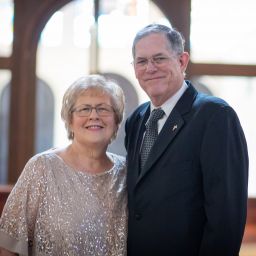
During the evening, Father Anyama presented the St. John Vianney Award to Dorothy and John O’Dwyer. Instituted in 2018, and named after the patron saint of priests, the award recognizes individuals who have demonstrated longstanding support for the seminary.
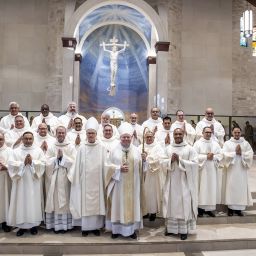
Four Holy Trinity alumni were also recognized for reaching 50 years of priestly service: Father Stephen Bierschenk, Father Stephen Mocio, Msgr. Henry Petter, and Bishop Robert Vasa of the Diocese of Santa Rosa, California.
Bishop Robert M. Coerver, a Dallas native and Holy Trinity alumnus who leads the Diocese of Lubbock, delivered the evening’s keynote address. He spoke about the importance of priestly formation and the role seminaries play in preparing men for ministry.
Bishop Coerver pointed to encouraging signs of growth in priestly vocations, noting that eight men are currently studying for the priesthood in the Diocese of Lubbock, the highest number since the diocese was established in 1983.
He credited, in part, the propaedeutic stage of formation, which gives men time to develop their spiritual lives, pray in community, and discern their vocations before advancing to the discipleship stage of formation.
Bishop Coerver praised Holy Trinity for ensuring that every seminarian has completed a propaedeutic program this academic year.
“I think the propaedeutic year is the best thing that’s happened in priestly formation in centuries,” Bishop Coerver said. “We find it so beneficial to introduce the men to community life, to communal prayer, to cultivating their identity as seminarians, and to being present throughout the diocese.”
He stressed the importance of providing the program with its own dedicated space as Holy Trinity moves forward with its plans.
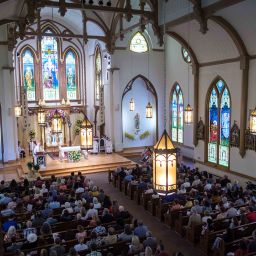
In a homily delivered at Holy Trinity Seminary on Oct. 11, Bishop Burns recalled the circumstances surrounding its establishment in 1965 by Bishop Thomas K. Gorman, the fourth bishop of Dallas.
Bishop Gorman, who also helped establish the University of Dallas in 1956, recognized that the growing Catholic community in North Texas needed more than churches, schools, and other institutions. It also needed well-formed, dedicated, and holy priests.
“Priests who would celebrate the Eucharist. Priests who would forgive sins in the sacrament of reconciliation. Priests who would baptize our children, witness marriages, anoint the sick, and accompany families through the joys and sorrows of life,” Bishop Burns explained. “Above all, priests who would ‘bring people to Jesus Christ, and Jesus Christ to His people.’”
Holy Trinity moved into its present facilities in 1967. Since then, it has formed hundreds of priests whose ministry has reached more than 40 dioceses and archdioceses across the country. Its graduates include 11 bishops.
Bishop Burns described the seminary as much more than a place of academic study or residence. Its purpose, he said, is to prepare men to give their lives in service to others.
“A seminary, therefore, is not simply a school,” the bishop said. “It is not merely a residence. A seminary is a place where men are prepared to give their lives so that others may encounter Jesus Christ.”
Bishop Burns said the planned new building will provide men entering seminary a dedicated place to deepen their relationships with Christ, establish lives of prayer, and discern their vocations.
The project will require the support of the faithful, the bishop said.
“We are not simply asking you to help us construct a building,” he said. “We are asking you to help us build the future of the priesthood.”
He described the project as an investment in generations of priests who will serve the Church for decades to come. Through the celebration of Mass, the sacraments of reconciliation and baptism, care for the sick, and support for families, a priest’s ministry can touch thousands of lives.
Bishop Burns also challenged the seminarians to recognize the responsibility that comes with discerning a vocation. Reflecting on the Gospel parable of the wedding feast, he reminded them that answering God’s invitation requires a daily commitment to prayer, study, humility, obedience, and formation.
“The Church does not simply need more priests,” he said. “The Church needs holy priests.”
Such holiness, he said, requires more than facilities, academic degrees, or financial resources. It requires each seminarian to cooperate with God’s grace and allow Christ to shape his heart after the example of the Good Shepherd.
The work of preparing future priests, Bishop Burns reminded the faithful, begins long before a man arrives at the seminary. Some future seminarians may still be in high school or college. Others may be working in professions or have not yet considered a vocation to the priesthood.
“God already knows their names,” he said.
Holy Trinity’s responsibility is to provide those men with a community ready to welcome them and an environment prepared to help them discern and grow in their vocations.
As the seminary marks more than 60 years of priestly formation, its focus remains on the generations still to come.
“What Bishop Gorman began in faith,” Bishop Burns said, “we are now called to carry forward with courage.”
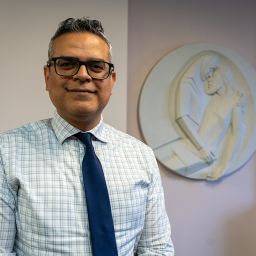
Cutline for featured image: Father Vincent Anyama, rector of Holy Trinity Seminary in Irving, delivers remarks during the 2026 Spes Gregis Benefit, which was hosted at the Cardinal Farrell Student Center of the seminary on Oct. 24. (KEVIN BARTRAM/Special Contributor)