By Michael Gresham
The Texas Catholic
On a recent Tuesday evening, a small group gathered online via Zoom to study the First Letter of St. Paul to the Corinthians. The discussion focused on a passage describing how St. Paul organized a collection to support struggling communities, marking an early example of solidarity across distance and difference.
For Melba Addison, who facilitates the weekly Bible study for St. Elizabeth of Hungary Catholic Parish, the lesson did not end when the call logged off.
“This sparked a conversation about our homeless population,” Addison said. “A few of us got together and began brainstorming to see what we could do to help.”
That question became the foundation for “Hope for the Homeless,” a parish initiative supporting one of North Texas’ most vulnerable and often overlooked populations: young people aging out of foster care.
What began as a conversation among a handful of parishioners quickly turned into faith in action. The group began researching homelessness in the region, initially hoping to make a modest contribution. What they found, Addison said, was a crisis far larger than expected.
“We realized that the problem was much larger than us,” she said, adding that the group narrowed its focus to young adults transitioning out of foster care, many of whom face housing instability, limited support systems, and few resources as they enter adulthood.
The group members’ search led them to the Transition Resource Action Center, a North Texas nonprofit serving individuals ages 16 to 24 who are aging out of foster care or already experiencing homelessness.
Founded in 2003, TRAC provides housing support, life-skills training, and other services designed to help young people move toward independence.
A leap of faith and a ‘yes’
The St. Elizabeth of Hungary group began modestly, pooling personal resources to assemble donations based on TRAC’s provided list of needs. After several rounds of giving, however, the group’s members had reached their limit.
“After our third donation amongst ourselves, we were out of our meager means,” Addison said. “So, we prayed for help.”
The answer that came, she said, was clear: Invite the wider parish community to participate.
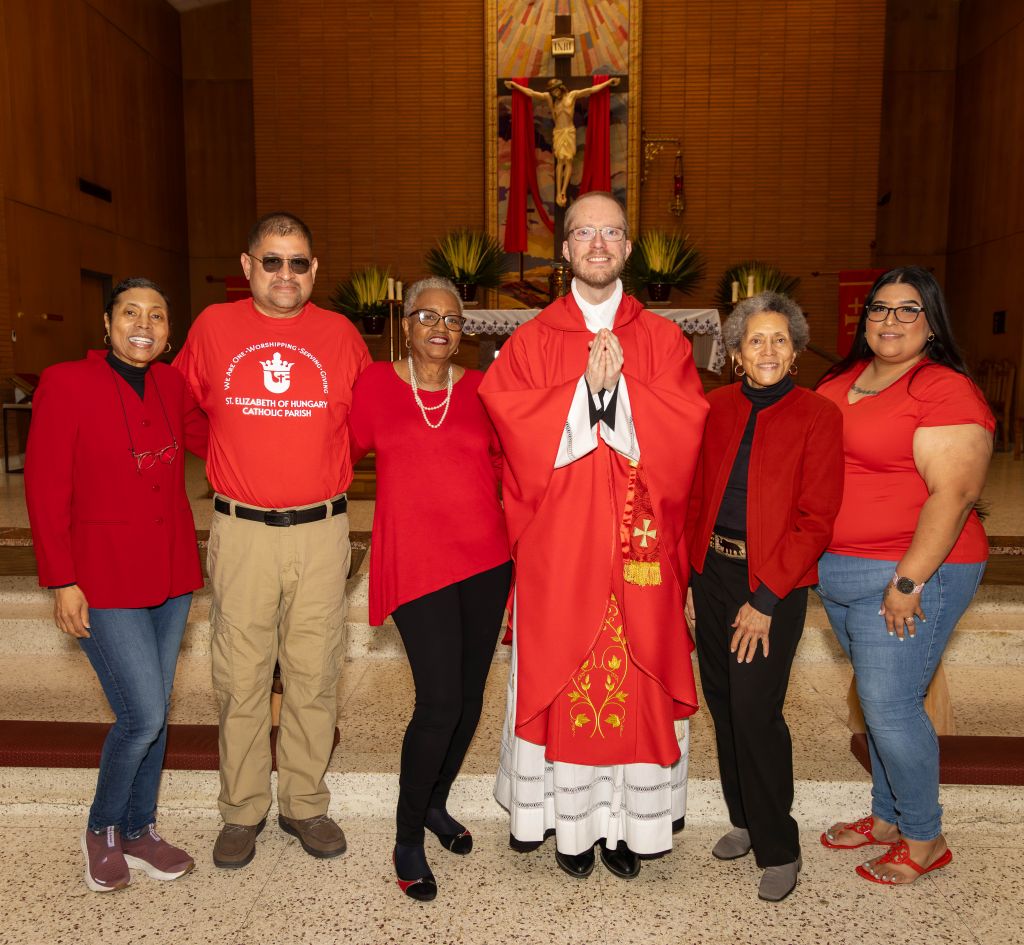
That meant approaching their pastor, Father Emmett Hall, with a request to organize a church-wide donation effort.
“I truly believe God had already prepared his heart,” Addison said. “He assigned us two weekends instead of the one that was requested.”
Father Hall said his decision to support the Bible study group’s initiative was rooted both in pastoral responsibility and a desire to see the effort thrive.
“I wanted to see it succeed,” he said, pointing to the Code of Canon Law of the Catholic Church. “Part of my responsibility as pastor is ‘to recognize and promote the specific role which the lay members of Christ’s faithful have in the mission of the Church.’”
With Father Hall’s support, the initiative quickly gained momentum. Donation tables were set up at the back of the church. Father Hall included the Hope for the Homeless initiative in his weekly reflection in the parish bulletin. Parishioners were invited to take part in what Addison described as “a true reflection of almsgiving.”
The response, Addison said, was immediate.
“The outpouring of donations … was so amazing,” she said.
Donations ranged from essential items to unexpected contributions. One parishioner donated 60 pairs of sunglasses, an item that might seem simple at first but became the centerpiece of a deeper act of connection.
Recognizing an opportunity to involve young people, the group invited students from the parish’s confirmation and youth ministry programs to participate. The students wrote handwritten messages of encouragement, which were placed inside the sunglasses’ cases.
“This is our way to be the bridge between foster care and independent living,” Addison said.
Father Hall said the effort embodies almsgiving and the heart of Catholic social teaching.
“Giving alms puts us in solidarity with the poor and reminds us of our own dependence on God, while at the same time giving us an occasion to imitate him in his generosity,” he explained. “If we have been successful, it is thanks to the working of the Holy Spirit.”
From a pastoral perspective, the parish pastor said the initiative reveals a deeper pattern of compassion and communal responsibility that defines the St. Elizabeth of Hungary community.
“I am proud of the way our parish contributes to the material relief of the poor, not only during Lent but throughout the year,” Father Hall said. “I see the warm response of the whole community in this particular initiative as one example among many.”
For example, Father Hall said, the parish’s St. Vincent de Paul Conference offers year-round financial assistance grounded in personal encounter and supports the monthly Catholic Charities Dallas Mobile Food Pantry.
“Our parish also contributed the ‘Most Pounds of Food Per Person’ to Catholic Charities at this year’s DCYC,” he said. “That is an effort of the whole community.”
For the St. Elizabeth of Hungary Bible study group members, the initiative is about more than meeting material needs, Addison said. It is about putting faith into action. She pointed to a prayer attributed to St. Teresa of Ávila: “Christ has no body now but yours … no hands, no feet on earth but yours.”
“Our parishioners are allowing Jesus to use their hands to help those who are less fortunate than ourselves,” Addison said.
Cutline for featured image: Donated items for the parish’s “Hope for the Homeless” initiative are placed upon a table at the back of St. Elizabeth of Hungary Catholic Church during Sunday Mass on March 15. (MICHAEL GRESHAM/The Texas Catholic)