By Father Thomas Esposito, O. Cist.
Special to The Texas Catholic
There are few things human beings can do that imitate God. One is to observe the Sabbath (see Gn 2:1-3; Ex 20:8-11); another is to rely on Mary.
At the core of the plea for Mary to “pray for us sinners” is the simple fact that God asked her for help; for that reason alone, we should as well.
The best visual illustration of this fact, for me at least, is the sanctuary wall of the church I pray in every day: Our Lady of Dallas Cistercian Abbey. Salvation history is spelled out in images here, starting from the top. Beneath three long rectangular windows, the Trinity is presented in a triangular relationship: A circle surrounds the Father above; the crucified Son is below to the left; and a dove symbolizing the Holy Spirit is below to the right. Beneath the three images is a lovely and large wood statue of Mary, her hands gently joined near her heart. (These four pieces, by the way, were not originally a set; they were smuggled individually out of Hungary during Communist persecution. That’s a cool story for another time.) Below Mary is the bronze door of the tabernacle.
We trace the story downward with our eyes: The eternal God, a communion of love between Father, Son, and Holy Spirit, enlisted the help of a Jewish girl to give a full human existence to the Son. Her obedience to this plan made possible the salvific work of Jesus. The fruits of his crucifixion and resurrection are available to us, because the triune God wanted Mary to participate in the great adventure of restoring wayward humanity, and indeed all of creation, in Christ (Eph 1:10). God had already graced her before the angel’s greeting (Lk 1:28) to be, as St. Thomas Aquinas wrote, “the noble resting place of the whole Trinity.”
Our role in this drama may be seen with an upward sweep of the eyes. The Eucharist we receive converts our bodies into living tabernacles. It allows us to imitate Mary during her pregnancy; we bear God the incarnate Son in our bodies, just as she did. And since she is the sinless glory of the human race, we can also beseech her help when we tarnish the tabernacle of our mind, body, and heart. Though sinless herself, she implores her Son to extend his mercy to us through her maternal intercession. She who conceived her Son by hearing the angel’s invitation has the ear of her Son. What God does for us through Mary allows us to share in the eternal joys that Mary already experiences in body and soul. Mary desires that each of us share with her the unmerited privilege of being partakers of the divine nature (2 Pt 1:4).
This is hardly a Middle Ages invention by devious papists bent on worshiping the Blessed Virgin. Already in the second century A.D., St. Irenaeus hailed Mary as “the advocate of Eve” whose obedient yes to the divine plan undid the knot of disobedience tied by Eve around the human will. And a specific prayer asking for Mary’s protection, dated to the middle of the third century, was found about 100 years ago on a papyrus unearthed from the Egyptian sands. We monks chant a modified version of this prayer daily at the conclusion of our morning prayers. It is known in Latin as the “Sub tuum praesidium”:
“We fly to your protection, o holy Mother of God.
Do not despise our petitions in our necessities,
But deliver us always from all dangers,
O glorious and blessed Virgin.”
There was no need for God to create us in the first place, nor was there any fated mandate that required him to redeem us from our pitiful sinful state. He was not forced to invite Mary to cooperate in the work of salvation. In hindsight, though, it was fitting for God to prepare a pure dwelling place for the incarnation of the Son. It is also fitting that we sinners should invoke Mary, the pure star above our stormy seas, to guide us to the fullness of life her Son wishes to give us, both now and at the hour of our death.
Father Thomas Esposito, O. Cist., is a monk at Our Lady of Dallas Cistercian Abbey and teaches in the theology department at the University of Dallas.
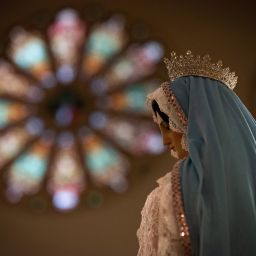
Cutline for featured image: A visitor kneels before a statue of the Blessed Mother at the National Shrine of Our Lady of Champion’s Oratory in Champion, Wis., July 1. (OSV News photo/Sam Lucero)