By Amy White
The Texas Catholic
A tiny church with a captivating — at times challenging — history, St. Peter the Apostle Catholic Church celebrates 120 years as a spiritual home to worshipers in the Dallas community.
Established as the first African American Catholic church in the Diocese of Dallas, the parish has survived more than a century of changes both within its walls and without — spanning the opening and closing of its school, a move from one church building to another, and the many difficulties and blessings of an ever-shifting Dallas community.
On the occasion of St. Peter the Apostle’s anniversary, members of the congregation spoke with The Texas Catholic about their parish’s history, reflecting on its impact in the local Church and sharing their gratitude for a faith family that continues to welcome all into its fold.
Freedom to worship
In 1905, when the city of Dallas, like the country at large, remained deeply segregated, St. Peter the Apostle opened its doors as a spiritual home for African American Catholics in the Diocese of Dallas.
The parish emerged in large part due to the efforts of Mary Stacker-Jordan, a previously enslaved person, and her husband, Valentine Jordan. Though not Catholics themselves, the couple believed a Catholic church and school for African Americans would benefit Dallas, a city where Black Catholics were often denied a place to worship freely.
Stacker-Jordan presented to then-Diocese of Dallas Bishop Edward Joseph Dunne a request to establish a Catholic parish and school in the Black settlement area of Dallas. The bishop approved the request; and, with a congregation of 12, the first African American church in the Diocese of Dallas was established.
“Establishing this church,” said Myrna Dartson, a lifelong parishioner of St. Peter the Apostle, “allowed African Americans to worship freely without having to be subjected to discrimination, segregation, or racism.”
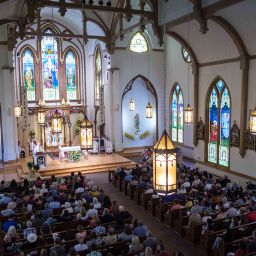
Then located at the corner of Allen and Cochran, the original parish building was repurposed from the Sacred Heart pro-cathedral, a simple white wooden structure that had been dismantled upon the construction of a new cathedral building. That structure was later replaced by a brick church, now at the corner of Allen and Woodall Rodgers, which continues to house the St. Peter the Apostle community today.
‘A place of love’
Shortly following the parish’s founding, the diocese established a school: the Sister’s Institute, later renamed St. Peter Parochial School and then St. Peter Academy. Erected under the leadership of Bishop Dunne and with the financial aid of St. Katharine Drexel and the Sisters of the Blessed Sacrament, it was the first Catholic school for Black children in the Diocese of Dallas.
“It gave [Black students] an opportunity to receive a good education when you still had segregation in the public school system,” explained Father David Edwards of St. Mary’s Catholic Church of Fannett and St. Martin de Porres Catholic Mission of Cheek, who became acquainted with the St. Peter the Apostle community while a seminarian at Holy Trinity Seminary; and along with the parish, “it opened the door to start to grow and develop your faith within your own community.”
Sylvia Martinez-Mendez, a 1984 graduate of St. Peter’s eighth grade class, recalled the school as “a family environment” full of love. Her most treasured memories from those school years were the Friday morning Masses spent worshiping in the church alongside classmates, teachers, and the Sisters of the Holy Spirit and Mary Immaculate of San Antonio, who begin teaching at the school in 1910.
“We were a very small church and a small school, but it was a family-like atmosphere,” she said. “You knew everybody. You knew people’s faces, families; you knew their hardships; you knew their accomplishments, everything… It was wonderful.”
Though the school building itself was simple — relying on factory fans rather than air conditioning to cool the space, according to former St. Peter Academy teacher Marcella Savala-Hamilton — “we just loved coming to work at that school,” she said. “You had parent support, parent cooperation. The kids were happy… It was just a place of love; it really was.”
A resilient community
Though St. Peter the Apostle proved to be a happy and vibrant environment, characterized by close family and community ties, the parish has faced its fair share of challenges over the years.
Father Edwards, for example, said that in his early encounters with the community, he noticed that the surrounding area still retained some of the look of the Freedman’s Town; but in time, he said, Dallas began to show signs of gentrification.
“When you talk to some of the parishioners, they say, ‘Over there was the meat market,’ or ‘over there was the soda shop,’ or ‘this was the store where we used to buy things,’” Father Edwards said. “Now, there’s no signs of them, because they’ve all been demolished and replaced by upscale homes and businesses and restaurants.”
At the same time that gentrification pushed many parishioners from the neighborhood, another change occurred. At the request of Bishop Thomas Tschoepe, St. Peter the Apostle welcomed into the church in the mid-1980s a small Polish community in search of a place to worship. The incorporation of the new community — with its own traditions, culture, and language — proved challenging at times for the small parish.
Soon thereafter, in 1987, St. Peter Academy closed its doors.
“A lot played into that: the gentrification of the neighborhood and the changes at the parish,” Savala-Hamilton said. Families began to relocate in search of new Catholic schools, parting with the parish. With the close of the school, the school sisters also departed, returning to San Antonio and leaving a vacuum in catechetical instruction that they had once filled.
With these many challenges, St. Peter the Apostle proved resilient. To fill the void left by the sisters, parishioners stepped into volunteer roles across the church; today, the parish remains a volunteer-run operation.
“We’re tiny but mighty,” said Martinez-Mendez — who volunteers as a catechist and safe environment officer, among other roles — and “we can get things done.”
While economic and demographic changes in Uptown pushed some families from the parish, others have joined, attracted by the parish’s welcoming congregation, as well as by its opportunities for weekday adoration and confession.
“We are diverse,” Dartson said, describing the current makeup of the community. “We are African American, Hispanic, Italian, Asian. We are a big melting pot. We are a big family.”
As in its early days, the parish remains a home, a faith family, where parishioners recognize each other’s faces, where they know each other’s names, parishioners said.
“I tell people, ‘Welcome. This is your home. Our doors are always open to you,’” said Savala-Hamilton, who volunteers to make announcements at the end of Sunday Masses. “Every pew is full of people. It’s beautiful.”
120 years
In recognition of St. Peter the Apostle’s long history of faith, community, and resilience, the parish commemorated its 120th anniversary with a two-part celebration: a banquet, hosted at DoubleTree by Hilton Hotel Dallas on Nov. 8, and a Mass, hosted at St. Peter the Apostle Catholic Church on Nov. 9.
The anniversary, Martinez-Mendez said, signifies an important truth: St. Peter the Apostle, once established as a haven for African American Catholics in Dallas, remains a spiritual home to its parishioners.
“We’re still standing; we’re still here; and we’re still thriving,” Martinez-Mendez said. “We are still here counting how many blessed years the Lord has given us with this church.”
Father Edwards hailed the milestone as an opportunity to praise God for the many blessings that “a little bitty church with an interesting and challenging start” has provided to the people of God in Dallas.
“The fact that this church has survived everything in dealing with the human condition — segregation, diversity, economic changes,” the priest said, “that the church is still there and Jesus Christ is still made present at every Mass that has been celebrated there for 120 years, that’s the grace of God.”
The 120-year milestone is profound not only for the parish but for the local Catholic Church, noted St. Peter the Apostle’s Father Jacek Wesołowski, S.Chr.
“In a time of great social and racial division, this church became a place of dignity, hope, and worship — a cornerstone for generations of Black Catholics who found strength in their faith and community,” the priest said. “Through 120 years of service, prayer, and perseverance, St. Peter the Apostle Catholic Church remains a beacon of faith, hope, and welcome — a place where all who seek God can find a home and a family in Christ.”
Cutline for featured image: Members of the St. Peter the Apostle Catholic Church community pose for a photo following Mass on Oct. 26. From left, Daniel Clarke, Alicia Goffney, Myrna Dartson, Sylvia Martinez-Mendez, Winona Smith, and Marcella Savala-Hamilton. The parish commemorated its 120th anniversary with a banquet on Nov. 8 and Mass on Nov. 9. (AMY WHITE/The Texas Catholic)