By Gina Christian
OSV News
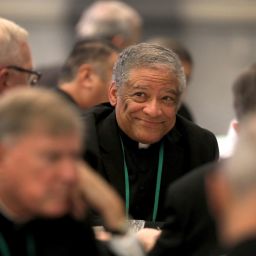
Consecrated men and women “reveal God’s invitation to love him with one’s whole life” on earth, in hope of doing so eternally in heaven, said Archbishop Ronald A. Hicks, chairman of the U.S. Conference of Catholic Bishops’ Committee on Clergy, Consecrated Life, and Vocations.
The archbishop shared his thoughts in a Jan. 27 statement ahead of the World Day of Prayer for Consecrated Life, established by St. John Paul II in 1997 and observed by the Catholic Church on Feb. 2.
Accompanying the archbishop’s statement was an annual report commissioned by the USCCB on men and women religious who professed their perpetual vows in 2025.
The report — conducted by the Center for Applied Research in the Apostolate at Georgetown University, with an overall response rate of 72% (520 of 723 major superiors) — showed that 82% said their communities had no perpetual professions in 2025.
Another 10% had one such profession, while 8% had two to nine, for a total of 179 professions of perpetual vows representing 74 women and 105 men.
Of those institutes with perpetual professions in 2025, 54% were for women and 46% for men.
Most of the institutes (86%) were active orders — whose sisters, brothers, and religious priests serve in an array of ministries among society — while 14% were contemplative, with nuns and monks devoting themselves in enclosure to prayer and reparation on behalf of the world, while supporting themselves through donations, religious goods production, and retreat services.
A third (32%) of the institutes had less than 50 professed members, with another third (34%) counting 51-150 and just under a quarter (24%) having more than 151.
Among the responding active orders, 58% “have a combination of primary apostolates that include healthcare, education, and pastoral ministry,” CARA said.
CARA said that by Jan. 7, 130 perpetually professed religious from the 2025 class — 59 sisters and nuns and 71 brothers and priests — had participated in the study, which examined their age, ethnicity, and educational, family, and religious backgrounds.
The average age of the responding religious was 38, with half age 35 or younger. The full age range of the 2025 perpetual profession class spanned 22 to 74 years.
In the USCCB’s online profile of several members of the 2025 perpetual profession class, Sister Barb Giehl, a member of the Sisters of Mercy of the Americas, noted that she had entered her order as a candidate at the age of 58, having been widowed after 31 years of marriage.
She described her “second vocation” as “an incredible gift,” noting she had “first considered religious life while in high school” — consistent with the report’s finding that respondents reported being 18 years old when they first did so.
The majority of the survey respondents (69%) were U.S.-born, with 12% born in Asia, 9% in Latin America, and 7% in Africa.
More than half (57%) identified themselves as Caucasian, European American, or white, while 16% listed their ethnicity as Asian, Pacific Islander, or Native Hawaiian; 16% as Hispanic or Latino; 9% as African, African American, or Black; and 3% as mixed race or “other.”
An overwhelming majority (92%) of respondents indicated they have been Catholic since birth, with 85% reporting that both of their parents were Catholic and 95% saying they had been “raised by their biological parents during the most formative part of their childhood.”
Most (85%) said they had been raised by a married couple living together, and almost all (98%) reported having at least one sibling, with 38% counting two or three and 39% four or more.
More than one third of the respondents (35%) also said they had a relative who was either a priest or a member of a religious community.
CARA said that the responding religious were “highly educated,” with 73% earning an undergraduate or graduate degree before entering their respective religious institutes.
Sister of Notre Dame Nicole Varnerin said in the USCCB’s 2025 profession class profile that she had a deep love for science and a background in electrical engineering.
“I spent 5 years in medical research before entering my community,” she noted.
Franciscan Friar Brother Jimmy Kernan of the Order of Friars Minor said in his profile that he is still making use of his prior education and training, and he now has “the wonderful gift and opportunity to use my talents as a scientist and educator to help respond the cry of the earth and cry of the poor.”
Father Hung Pham, a member of the Congregation of the Priests of the Sacred Heart, also known as the Dehonians, said in his USCCB profile that he had completed a degree in petroleum engineering at the University of Houston before taking his first vows in 2020.
Just 8% of survey respondents said educational debt — which among respondents averaged $55,500 at the time of making perpetual profession — had delayed their application for entrance into religious life, on average by two years. Friends and family were cited as the key sources of assistance for those with educational debt.
Slightly less than half (47%) of the survey respondents had attended a Catholic elementary or middle school, while just over a third (35%) had attended a Catholic high school. Another 13% said they had been home schooled at some point, on average nine years. Well over half (60%) had participated in some form of parish religious education program.
The majority of respondents (84%) had worked — most in business or education — before entering religious life, with 61% employed full-time and 23% part-time.
An even higher percentage (95%) said they had served in one or more ministries, either on a paid or volunteer basis, before their entrance into religious life. Altar server topped the list at 60%, followed by lector (57%), youth or campus ministry (56%), and faith formation (56%).
A majority (81%) had participated in religious programs or activities prior to their entrance, especially youth ministry (63%) and Catholic campus ministry (57%).
Retreats (79%) topped the regular prayer practices cited by respondents prior to their entrance into religious life, particularly by men (83% as opposed to 73% of women).
In contrast, the rosary — listed by 77% overall — was more frequently named by women (84% as opposed to 71% of men).
Other key practices named by respondents were Eucharistic adoration (71%), spiritual direction (67%), faith sharing or Bible study (54%), the Liturgy of the Hours (52%), and lectio divina, or contemplative spiritual reading (47%).
Personal encouragement also fostered discernment of a religious vocation, respondents said, with 86% noting they had experienced such support. At the same time, more than half (53%) were discouraged from considering a religious vocation, with women more likely to report such efforts to be deterred.
Survey respondents said on average they knew the members of their respective religious institutes for six years prior to entrance, and the majority (92%) had participated in at least one vocational discernment program, typically a “come and see” experience (78%).
Amid the report’s demographic drill down, one member of the 2025 religious profession class indicated that true vocations can defy all odds.
“I once tried to outsmart God with a bargain I thought he could not pull off,” admitted Sister Mary Augustine Pham, a member of the Dominican Sisters of Mary Immaculate Province, in her online USCCB profile.
Ultimately, she said, “I began to understand, like St. Augustine, that the restlessness I kept trying to ignore was really His voice inviting me to rest in Him, the One I now know as my Bridegroom.”
Cutline for featured image: Priests hold candles as they wait for Pope Francis to arrive for Mass with consecrated women and men marking the feast of the Presentation of the Lord and the World Day for Consecrated Life in St. Peter’s Basilica at the Vatican Feb. 2, 2018. (CNS photo/Max Rossi, Reuters)