By Rebecca Omastiak
The Catholic Spirit, OSV News
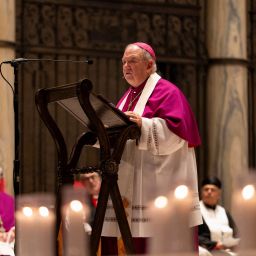
ST. PAUL, Minn. — Ten years ago, Archbishop Bernard A. Hebda was reflecting on how he hoped to encourage vocations in the Archdiocese of St. Paul and Minneapolis.
“First is to sustain family life,” he told The Catholic Spirit in an interview published in a May 26, 2016, special issue of the archdiocesan newspaper celebrating his installation May 13.
“To the extent that we’re able to help our families or to help our married couples to see the life that they’re living is being a life of vocation, to the extent that we’re able to get them to be praying that their children might be able to respond however God might be calling them to serve,” he said, “I think that’s going to have a positive impact on vocations.”
Ten years after his installation on the feast of Our Lady of Fátima, the archbishop is releasing his newest pastoral letter, titled “Only One Thing Is Necessary,” to families.
That the archbishop spoke about sustaining families at the time of his installation to the present release of his latest pastoral letter shows that “that’s Archbishop’s heart,” said Corey Manning, executive director of the archdiocesan office of Discipleship and Evangelization.
“He truly wants marriages and families to be filled with joy and that divine life and that love,” Manning, a member of St. Michael in Stillwater, told The Catholic Spirit. The archbishop’s “desire hasn’t changed in 10 years, to accompany and to walk with” faithful families.
The letter’s title draws from the Gospel of Luke, in which Jesus tells Martha that amid her anxiety, “There is need of only one thing.” (Lk 10:42) “Jesus Himself is that one true thing,” the archbishop wrote.
In a May 4 “Together on the Journey” video about the letter, Archbishop Hebda said that “Our Lord is the way through which Catholic families can be united in this life and the next.”
Throughout the letter, the archbishop looks to the example of Sts. Zélie and Louis Martin — parents of St. Thérèse of Lisieux, a doctor of the Church — to guide families.
“I have been constant in my prayers that they would intercede for the families of this Archdiocese,” Archbishop Hebda wrote in the letter’s preface.
Drawing from his own familial experience, the archbishop wrote that “my siblings and I often speak of our indebtedness to our parents for their witness to the faith and their willingness to sacrifice for their family. We will always be grateful for the way they introduced us to God’s love and made sure that we found a home in our Church.”
Archbishop Hebda wrote that he has seen many parents express this same zeal during prayer and listening sessions that led to the 2022 Archdiocesan Synod.
“I heard time and again of the love and concern that reside in the hearts of so many parents in this local Church, who want nothing more than to lead their families to Jesus,” he wrote.
A high number of votes during the 2022 Archdiocesan Synod indicated interest in a proposition of “parents as the first teachers of their children in the ways of the faith.”
Next steps included the formation of a Blue Ribbon Commission — made up of clergy, religious, educators, parents, and grandparents — to help advise the archbishop on ways to support parents.
Responding to the Archdiocesan Synod and the archbishop’s 2022 pastoral letter “You Will Be My Witnesses,” one of the commission’s recommendations was what ultimately became the “Only One Thing Is Necessary” pastoral letter. The archbishop wrote that the newest letter is “an expression of encouragement to parents and to all those who support them pastorally.”
Archbishop Hebda acknowledged what families have expressed to him as “what can seem to be an uphill battle,” living amid “a general societal decline in religious practice and church affiliation.”
According to the 2023-24 Religious Landscape Study released in 2025 by the Pew Research Center, Christians — who represent the largest share of religiously affiliated adults in the United States — “have been declining as a percentage of the U.S. adult population, while the share that is religiously unaffiliated has been rising.”
The Catholic share of the U.S. adult population, meanwhile, had also ticked down in recent years, according to Pew researchers — from 24% in 2007, to 20% in 2014, to 19% in the 2023-24 study. These declines however, Pew researchers reported, had appeared to be leveling off with the most recent 2023-24 RLS data.
Alongside changes in religious affiliation and practice, the archbishop noted challenges that modern couples face, including that there is “a significant decrease in the number of couples seeking the Sacrament of Matrimony or even choosing to marry civilly.”
According to the U.S. Census Bureau data published in 2025, 47% of U.S. households in 2025 were married couples, what the bureau called “a significant shift” from 50 years ago, when 66% were in 1975.
In his letter, the archbishop included the late Pope Francis’ words, that “today’s frenetic pace, fears about the future, the lack of job security and adequate social policies, and social models whose agenda is dictated by the quest for profit rather than concern for relationships” could be viewed as factors contributing to declining birthrates.
Census data indicated that the share of U.S. married-couple households with their own children under the age of 18 had declined from 54% in 1975 to 37% in 2025.
The archbishop also acknowledged that many families face modern concerns.
In 2023, the U.S. Surgeon General Vivek Murthy connected an “epidemic of loneliness and isolation” to diminished social connection during the COVID-19 pandemic as well as a general shrinking of social networks and declining social participation; decades-long declines in family size and marriage rates; declining trends in community involvement, “including with religious groups, clubs and labor unions”; and burgeoning technologies — including “social media, smartphones, virtual reality, remote work, artificial intelligence, and assistive technologies” — that “have quickly and dramatically changed how we live, work, communicate and socialize.”
In his letter, Archbishop Hebda acknowledged both the “perennial challenges” and “challenges particular to our time” that modern Catholics experience, advocating for spending time engaged in in-person dynamics.
“What would our families and our society look like if we spent but a fraction of what we spend on screens looking at the faces of our family members?” he wrote.
Archbishop Hebda encouraged families to “take heart,” including the words of St. John Paul II in his letter: “The future of humanity passes by way of the family.”
The archbishop suggested families must embrace the “narrow way” that Jesus identifies in Matthew 7:13-14. “To be certain, perseverance on the narrow path requires the grace that flows from our rooted friendship with Jesus Christ. Only within the context of that essential relationship can our other relationships be directed toward our highest calling: eternal life with God.”
“You, dear families, are made for eternal life,” he wrote.
In the video about “Only One Thing Is Necessary,” Archbishop Hebda said that “each of us, regardless of our state of life, is called to accompany families.”
“How do we know that families are so important? Our Lord chose the family as the way that he entered into our human experience,” he said, encouraging the faithful to read the letter and to pray with it.
Alongside the pastoral’s release are tools for all the faithful to participate in the effort “to strengthen the culture of family life in the Church and local communities.”
The archdiocesan offices of Discipleship and Evangelization and for the Mission of Catholic Education developed a series of pastoral letter implementation steps.
The steps provide recommendations to parents and families; clergy; parish staff; parish small groups; Catholic school staff; seminarians; consecrated women and men; and members of Catholic ministries and apostolates; among others in the archdiocese, as they read and reflect on the letter.
Alison Dahlman, associate director of educational quality and excellence for the office for the Mission of Catholic Education, highlighted parish small groups as one avenue of reading and reflecting on the pastoral.
“If every small group uses this for their content for the year, what a unifying power that is,” she said.
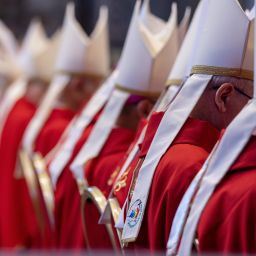
Cutline for featured image: People pray during a Mass at the Basilica of St. Mary in Minneapolis Feb. 1 to celebrate the 100th anniversary of the church being named a minor basilica by Pope Pius XI. Archbishop Bernard A. Hebda of St. Paul and Minneapolis, who was the main celebrant, marked the 10th anniversary of his installation as archbishop on May 13 with the release of a new pastoral letter, titled “Only One Thing Is Necessary.” (OSV News photo/Dave Hrbacek, The Catholic Spirit)