By Father Jacob Dankasa
Special to The Texas Catholic
Every year at the end of July, our parish staff sets aside a week for staff development. This is a time to pause, reflect, and prepare our hearts and our ministries for the coming school and faith formation year. It’s a week of spiritual renewal, shared learning, and, yes, even a bit of office cleaning as we reset for the months ahead. We invite speakers, share stories, and encourage one another in the mission we carry together.
This year, on the very first day, one particular moment stayed with me. A staff member spoke about something she and her family had done at home: They “made Alexa Catholic.” She was referring, of course, to the Amazon Alexa device many of us have sitting on a kitchen counter or tucked into a corner of the living room, always ready to answer a question, play a song, or remind us of an appointment.
We often hear mixed reviews about these devices. Some people have stopped using them, worried that they listen too closely. Others complain that virtual assistants may occasionally misunderstand a question and respond with something inappropriate or not family friendly. Technology, as we know, comes with its blessings and its burdens.
But, in the midst of these concerns, this staff member’s story offered a refreshing and hopeful perspective.
She explained that in their home, they customized the virtual assistant to support their family’s devotional life. They configured routines or reminders in it — intentionally — to help them stay rooted in prayer. At noon and at 6 p.m., it announces that it’s time to pray the Angelus, and then begins the prayer aloud as the whole family stops what they’re doing and joins in. At 3 p.m., it reminds them to pray the Divine Mercy Chaplet. Other daily devotions follow the same pattern. Over time, their young children have grown so accustomed to these rhythms that prayer has become a natural part of their day.
I found this profoundly inspiring. We live in a world where technology is woven into nearly every moment of our lives, especially the lives of our young people. We may not be able to eliminate every negative influence that comes through our devices, but we can choose how these tools are used. We can teach our children — and remind ourselves — that technology should serve us, not the other way around.
By “making Alexa Catholic,” I mean any technology that can be intentionally used to support our faith. It’s not about the device itself; it’s about the intentionality behind it. We cannot stop the advance of technology, nor can we realistically keep our children away from it entirely; but we can infuse our Catholic identity into the spaces where technology lives. We can make our homes places where faith is present not only in the crucifix on the wall or the Bible on the table but also in the digital tools we use every day.
I have also tried to put this principle into practice in my own life. Because I enjoy using technology, I purchased a tablet dedicated exclusively to prayer and spiritual reading. It contains only the iBreviary, a Catholic Bible, and a few prayer books. There is no email, social media, or web browsing — nothing to distract from time with God. Before the invention of the printing press, Christians encountered Scripture through scrolls and handwritten manuscripts. Today, whether I pray from a printed Bible or from this dedicated tablet, I am encountering the same Word of God. By setting this device apart for prayer alone, I have found it easier to remain focused and to let technology serve my spiritual life rather than compete with it.
Imagine setting your virtual assistant to read the daily Scripture passage while you prepare breakfast. Imagine choosing wholesome Catholic children’s books that it can read aloud during quiet time. Imagine using technology to reinforce the values we want our children to carry into adulthood. Technology can be morally neutral; its value depends on whether we use it to draw ourselves and our families closer to Christ.
Another staff member shared a simple but powerful practice: using phrases like “Bible before Bed” or “Bible before Breakfast” as family rules. These gentle reminders help keep priorities in order and encourage children to begin and end their day with God’s Word. These are small habits, but they shape hearts over time.
Young families today face many challenges. The noise of the world is loud, and the pace of life is fast. But the tools that sometimes distract us can also help us refocus if we use them with purpose.
So, I encourage you to be intentional. Let your Catholic identity shape the way technology is used in your home. Teach your virtual assistant — quite literally — that your household is a Catholic household. Let it call your family to prayer. Let it help you bring Jesus into the ordinary moments of your day. At the same time, always be mindful that technology can only assist prayer — it should never replace personal prayer, Scripture reading, or family leadership.
Technology will continue to evolve, but our mission remains the same: to make Christ present in our homes, our families, and our daily routines. If Alexa can help us do that, then perhaps it’s time we all consider making Alexa a little more Catholic. The question is not whether our virtual assistants are Catholic. The real question is whether our homes are intentionally ordered to help us grow closer to Christ.
Father Jacob Dankasa is the pastor of Holy Family of Nazareth Catholic Parish.
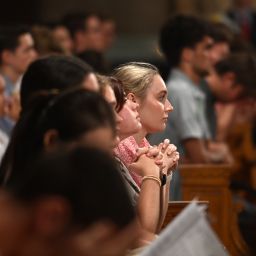
Cutline for featured image: People join in praying the rosary during the Family Rosary Crusade at Civic Center Plaza in San Francisco in 2011. (CNS photo/Jose Luis Aguirre, Catholic San Francisco)