By Kimberley Heatherington
OSV News
WASHINGTON — Artificial intelligence is quickly bringing about the end of the world as people know it — but Pope Leo XIV has an urgent message for everyone: Don’t run from the change AI brings; instead, engage it.
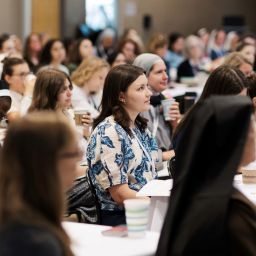
That was just one of the take-aways from an Aug. 1 conference at the St. John Paul II National Shrine in Washington exploring the pope’s recent encyclical “Magnifica Humanitas: On Safeguarding the Human Person in the Time of Artificial Intelligence.”
Peter Cooney, co-founder of the website platform Acutis AI — named in honor of St. Carlo Acutis and designed as a Catholic alternative to mainstream AI systems by offering responses rooted in Church teaching — walked attendees through Pope Leo’s lengthy document.
“He opens up on a strong note: Humanity is facing a pivotal choice. He gets straight to it. If you look at other encyclicals, they usually open on a much softer note,” said Cooney, 21, an incoming senior and Economics major at the University of Dallas. “So, I think what Pope Leo is telling us is: This is important — listen up; pay attention.”
And there’s good reason to — given the speed with which AI is spreading into all corners of everyday life.
Cooney noted that on Nov. 30, 2022, the launch of ChatGPT, a generative AI chatbot, was announced on the social media platform Twitter, now known as X. Within five days, it had over a million users — now, less than four years later, there are over a billion monthly active users.
“This is the fastest growing technology we’ve ever seen in the world,” Cooney said, “and I think there are a few things to note about this technology that makes it different than in the past.”
Among those differences, he said, is the diversity of AI users (everyone from kids to the military); concentrated AI ownership (Cooney estimated less than 10 companies own 95% of the current market); and the competitive AI race between the U.S. and China (with the goal of weaponizing the powerful technology).
“So what you have is a few companies in two of the most powerful nations of the world competing to create the smartest AI models; to have a military advantage,” Cooney emphasized. “And that same technology is on kids’ Chromebooks in their classrooms. This is the world that the Holy Father is addressing.”
Still, the Catholic Church is not without answers.
With this encyclical, Pope Leo has “established the Church as a moral authority on this topic,” Cooney said, “which gives tech leaders good reason to read the rest of what he has to say.”
The pontiff, Cooney said, notes three particular AI dangers: the ease of obtaining results; its impression of objectivity where it doesn’t actually exist; and its ability to simulate human communication.
While AI can be genuinely helpful, “If we’re never thinking through things anymore and just outsourcing all of that to AI, then we’ll lose the ability to think,” Cooney suggested, “which is a huge part of what makes us human.”
He also confirmed that for AI, “every answer is based on probability. It’s basically doing math and finding the highest probability of the next word being correct,” Cooney said. “AI is not neutral.”
As to human communication, Cooney added, “If we’re not careful, we can allow AI to slowly take away our human relationships … it can deteriorate human relationships.”
Cooney observed that Pope Leo says these threats place truth, work, and freedom in jeopardy.
Truth, because AI amplifies the problem of misinformation through the ability to manipulate images or videos; work, because using AI to replace employees compromises their human dignity; and freedom, because it’s easy to feel like you’re choosing while your choices are actually heavily influenced by AI.
And yet, Cooney confirmed, Pope Leo is ultimately hopeful.
“He doesn’t say to hide from AI or run away from it. He acknowledges all the dangers and the confused and afraid state of the world,” Cooney said, “but he calls us to build. He says, despite this downward spiral, we can also glimpse a great part of humanity that is striving … to build the holy city.”
Pope Leo’s “Magnifica Humanitas” commissioning of people to take up their role as disciples of Jesus Christ in an “era of digital transformation” is indeed evocative.
“Let us not be afraid to get our hands dirty on the ‘construction site’ of our time,” Pope Leo writes in the encyclical. He urged people “not to be passive spectators of social and cultural fractures, nor mere commentators on what is crumbling, but men and women prepared to enter the construction sites of history — research laboratories, technology companies, schools, the media, institutions and local communities — in order to rebuild what has collapsed and protect what is threatened.”
Pope Leo’s call to men and women today, Cooney said, “is to build without fear, to protect our children, and to trust everything to Mary.”
In order to live out Pope Leo’s summons, Cooney noted three personal suggestions.
“We can’t be afraid of AI. We have to learn how to use it — and learn how to use it well,” he said.
He also urged parents “to have conversations with kids — and have a conversation with their schools, to find out how is AI being used. Because it’s being used in pretty much every school … it’s important that they have an understanding of how it works and how it has problems sometimes.”
And finally, Cooney advised prayer.
“I would say try to pray a few Hail Marys every day for world peace,” he said, “and that the world can figure this out together.”
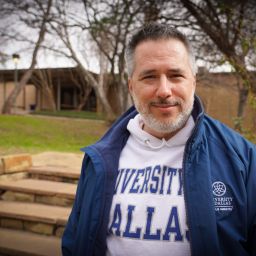
Cutline for featured image: Peter Cooney (right) and his brother Thomas, who co-founded Acutis AI, a website platform designed as a Catholic alternative to mainstream AI systems that offers responses rooted in Church teaching, are seen in an undated photo. (OSV News photo/courtesy of AcutisAI)