By Father Thomas Esposito, O. Cist.
Special to The Texas Catholic
After singing the biblical praises of Mary, the second half of the Hail Mary prayer draws on the Church’s teaching about her singular role in salvation history. Given the simple piety expressed in the prayer and the rosary itself, we easily forget that the title “Mother of God” is the fruit of a tremendous battle for theological orthodoxy fought more than 1,500 years ago.
The difficulty does not lie with the salutation “Holy Mary.” It is Jesus who is called “holy” in Luke 1:35, but we rightly call Mary holy because the radiance of her Son’s holiness shines upon her. The Church’s wisdom affirms that this radiance dawns upon Mary not at Jesus’ conception in her womb but from the very moment of her conception. Since only those who are purified can carry the vessels of the Lord (Is 52:11), Mary is purified, or conceived immaculately, with her Son’s conquest of original sin already foreseen. The honor given to Mary is always in reference to her Son.
But who exactly is her Son?
This is the key question behind the title “Mother of God.” Such a title for Mary raises immediate questions: How could the almighty and eternal God have a mother? Theologians and bishops in the early fifth century asked such a question. Nestorius, the bishop of Constantinople, was willing to assert that Mary is the “Christ-bearer” (“Christotokos”), but not the “God-bearer” (“Theotokos,” rendered in English as “Mother of God”). For Nestorius, “a true mother should be of the same essence as what is born from her;” since Mary is not in any way divine, she can only be saluted as the mother of the man Jesus Christ.
At first glance, Nestorius’ arguments seems convincing: Since Mary is a mere creature and not a goddess, she must be celebrated for the birth of Christ the human being and not for giving birth “to one older than herself.”
The principal defender of the title Theotokos for Mary was St. Cyril of Alexandria, who took charge of the Council of Ephesus in 431 in affirming this title as orthodox teaching. Cyril recognized that Nestorius understood Christ to be an inspired or glorified man, not true God made flesh. The consequences of that distinction are massive: Nestorius essentially divided Christ into two persons — the divine Son and the man Jesus. In a letter to Nestorius, St. Cyril outlined why it is proper and necessary to hail Mary as both “Christotokos” and “Theotokos”:
“So confessing the Word united hypostatically to flesh, we worship one Son and Lord Jesus Christ, neither putting apart and dividing man and God … nor speaking of the Word of God separately as Christ, and then separately of him who was of a woman as another Christ, but knowing only one Christ, the Word of God the Father with his own flesh.”
We meet here the complicated but decisive language and logic of the hypostatic union, namely: the two natures, divine and human, in the one person of Jesus Christ, the eternal Son of God made flesh. Mary, of course, does not precede God in any way, nor does she create God in her womb. Rather, she is the Mother of God insofar as God chose her to be the temple where he would dwell in the flesh:
“Since the holy Virgin gave birth after the flesh to God who was united by hypostasis with flesh, therefore we say that she is ‘Theotokos,’ not as though the nature of the Word had beginning of its existence from flesh.”
The title “Mother of God,” then, is bestowed upon Mary not to divinize her but to help us confess the true mystery of her Son, who is one person with a fully human and a fully divine nature perfectly united together.
The divinity of Jesus has always been questioned, attacked, minimized, and denigrated in myriads of ways from age to age. We should be honored to confess the orthodox faith about Our Lady and her Son with every recitation of this simple and profound prayer. Holy Mary, “Theotokos,” pray for us sinners!
Father Thomas Esposito, O. Cist., is a monk at the Our Lady of Dallas Cistercian Abbey and teaches in the theology department at the University of Dallas.
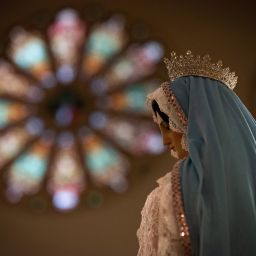
Cutline for featured image: A statue of Mary is seen at Old St. Mary’s Catholic Church in the Greektown neighborhood of Detroit in this 2015 file photo. (CNS photo/courtesy Archdiocese of Detroit)