By Father Thomas Esposito, O. Cist.
Special to The Texas Catholic
It is said that soldiers spilling their lifeblood on the battlefield often call for their mothers with their dying breath. In their violent exit from the world, they find comfort in remembering the maternal love that brought them into the world.
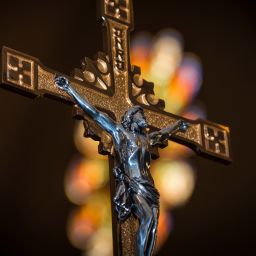
Jesus does not need to recall his mother’s memory as the violence of the crucifixion drains his life. We do not know how closely Mary followed Jesus during his passion, but all four Gospels note her faithful presence at the foot of the cross. In John’s Gospel, Jesus entrusts his mother to the Beloved Disciple: “When Jesus saw his mother and the disciple there whom he loved, he said to his mother, ‘Woman, behold, your son.’ Then he said to the disciple, ‘Behold, your mother.’ And from that hour the disciple took her into his home” (Jn 19:26-27).
The Beloved Disciple, traditionally understood to be John himself, represents every Christian, every beloved son or daughter of God the Father. We dare to call ourselves beloved children of God because Christ the Son has made that relationship possible for us by his death and resurrection. “If the Spirit of the one who raised Jesus from the dead dwells in you,” St. Paul wrote, “the one who raised Christ from the dead will give life to your mortal bodies also” (Rom 8:11). This fact brings us into joyful communion with the communion of the holy Trinity: “For those who are led by the Spirit of God are children of God. For you did not receive a spirit of slavery to fall back into fear, but you received a spirit of adoption, through which we cry, ‘Abba, Father!’” (Rom 8:14-15).
John has a different but complementary insight into this mystery. Just as the eternal Son “came into what was his own (eis ta idia)” by taking on human flesh (Jn 1:11), so the beloved disciple welcomes the mother of Jesus “into his own (eis ta idia)” (Jn 19:27). This is more than a reference to the physical home or practical care that John is to provide Mary in her Son’s absence; Jesus’ arrangement of the mother-son relationship turns every Christian into his brother and Mary into every Christian’s mother.
The concluding line of the Hail Mary prayer requires us to keep our death constantly before our prayerful eyes. Curiously, there is no mention at the end of heavenly consolation once we exhale our final breath. But the last stanzas of the “Stabat Mater” hymn, written sometime in the 13th century, complement the Hail Mary prayer with a note of calm hope — a hope, in fact, that we share with the good thief:
“Christ, when Thou shalt call me hence, / By Thy Mother my defense, / By Thy Cross my victory. / While my body here decays, / May my soul Thy goodness praise, / Safe in paradise with Thee.”
The devotion evident in the “Stabat Mater” and the Hail Mary is a beautiful part of the Church’s patrimony of faith. But undergirding these beautiful prayers is a profound philosophy of life. In a letter, St. Jerome emphasizes the distinctly Christian approach to death:
“The opinion of Plato (in the ‘Phaedo’) is that the entire life of wise men is a meditation upon death. The philosophers praise this and extol it to heaven. But the Apostle is much more emphatic: ‘By my boast in you,’ he says, ‘I die every day’ (1 Cor. 15:31). For it is one thing to attempt and another to do; one thing to live as if about to die and another to die as if about to live.”
Mary teaches us how to do both: to live with death properly in view and to die with the joyful awareness that her Son awaits us beyond our final breath. Jesus addresses her tenderly at the hour of his death; may it be our privilege to do the same.
Father Thomas Esposito, O. Cist., is a monk at Our Lady of Dallas Cistercian Abbey and teaches in the theology department at the University of Dallas.
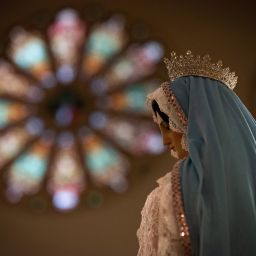
Cutline for featured image: A statue of Mary with a crown is seen at a cemetery in Nogales, Ariz., June 26. (OSV News photo/Bob Roller)