By Father John Bayer, O. Cist.
Special to The Texas Catholic
Every morning, monks and nuns — and many lay people — arise early for morning prayer. The Latin name for this prayer, “laudes,” means “praises.” Often the psalms that make up morning prayer are indeed full of expressions of praise. One has inspired in me a reflection on the liturgy. Here are the initial verses of Psalm 63.
“O God, you are my God, for you I long;
for you my soul is thirsting.
My body pines for you like a dry, weary land without water.
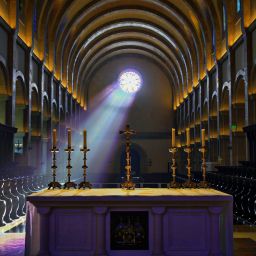
So I gaze on you in the sanctuary
to see your strength and your glory.”
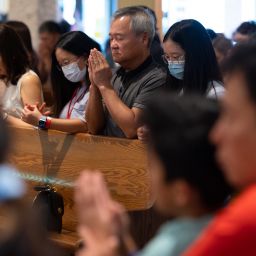
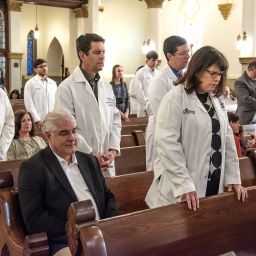
I like the image of thirsting and pining for the display of God’s strength and glory; and I like the idea that we see his strength and glory in the sanctuary, that is, in church. When we are in church, we can see God’s mighty action, and this sight satisfies all our longing.
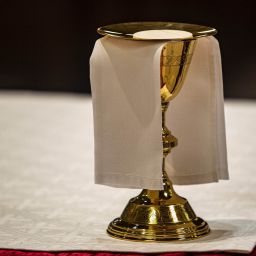
What happens in church that satisfies all our longing? It is the Mass. In the Mass, we see the strength and glory of God. That is because the Mass is in fact God’s action. I think we easily forget this, because we quite rightly go to church so that we can do something — namely, so that we can worship God; but we should remember that on our own, we cannot worship God as he deserves to be worshiped. In fact, one of the marvels of Christianity is to recognize that on our own, we cannot give God what God deserves; and that he, in his infinite mercy, has become a human being to restore to himself what is “right and just” — and then to enable you and me to restore it in union with him. In other words, our action at Mass is really to share in his action. When “we” celebrate the Mass, we are joining the self-offering of Jesus on the cross, rather than doing anything on our own. This is why everything we pray at Mass is “to” the Father, “through” the Son, and “in” the Holy Spirit. The real protagonist in the sanctuary is the Holy Trinity. It is his strength and glory that is on display.
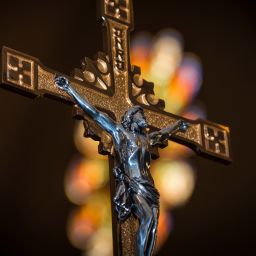
In the unity of the Holy Spirit, the Son is drawing all creation to himself so that he can offer it to the Father. He is like a magnet pulling everything to himself, especially our lives. To succeed, he must overcome the centrifugal forces of sin and death, because those forces would keep us from converging in his love. Let us praise the Son of God, for he found a way to overcome the effects of sin and death by turning them into something he can offer to the Father. This is what he does on the cross, where he endures death and the consequences of sin as an expression of his perfect obedience and love; and he draws us into his offering on the cross through the Eucharist: There he takes our efforts to offer ourselves and integrates them into his own. At Mass, he is “lifted up” to draw “everyone” to himself (Jn 12:32). Like a snowball rolling down the hill of history, at the Mass the Mystical Body of Christ gathers more and more humanity for God.
St. Paul described the great finale, which will happen when the Son has gathered all history and presented it to the Father: “When everything is subjected to him, then the Son himself will [also] be subjected to the one who subjected everything to him, so that God may be all in all” (1 Cor 15: 28).
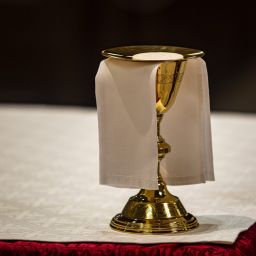
God wants to reign over the entire world. That is why Jesus commanded the disciples to celebrate the Eucharist: “Do this in remembrance of me,” he said. God wants us to offer our whole lives to him on the altar; and the obedience and love with which we endure our sufferings can now, in Christ, make even the consequences of sin and death into an acceptable offering. Now, we can bring our whole story to God, so that he can be all in all. At Mass, we can see him enacting the strong and glorious love that integrates and illuminates our entire lives. At Mass, we can see how to satisfy all our thirsting and pining through total union with him.
Before your next Mass, ask the Holy Spirit what, concretely, he wants you to give to the Son, so that he can offer you to the Father. Mass is not just about hearing an edifying message or praying in a generic sense. It is about sharing in God’s action. He wants your life. So, list concrete things to help you place yourself on the altar for Christ to purify and integrate into his Mystical Body, so that you might be offered through him, with him, and in him, in the unity of the Holy Spirit, for the glory and honor of the Father, forever and ever.
Father John Bayer, O. Cist., is a monk at the Cistercian Abbey of Our Lady of Dallas in Irving.
Cutline for featured image: View of the stained-glass windows during the inaugural Mass at Notre Dame Cathedral in Paris, five-and-a-half years after a fire ravaged the Gothic masterpiece, as part of ceremonies to mark the cathedral’s reopening after its restoration, in Paris, Dec. 8, 2024. (OSV News photo/Sarah Meyssonnier, Reuters)