By Michael Gresham
The Texas Catholic
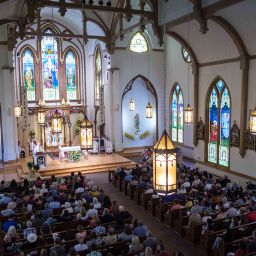
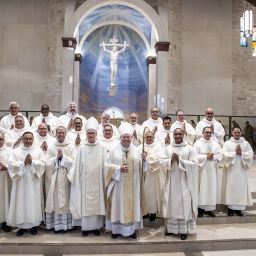
PLANO — Pews at St. Elizabeth Ann Seton Catholic Church in Plano were filled April 25 as Bishop Edward J. Burns ordained six men as transitional deacons for the Diocese of Dallas, marking a significant step in their vocation to serve the Church.
Bishop Burns pointed to the newly ordained deacons — Luiz Guilherme Alves Fernandes, Benjamin Zachary Crocker, Kyle Patrick Fletcher, Roberto Carlos Herrera, Ikechukwu Chetachi Iwuji, and Zak Russell Zapletal — as a sign of a Church “alive” with promise and as men whose lives “will be poured out in service,” proclaiming the Gospel, serving the poor, and accompanying God’s people.
“Their voices will proclaim the Gospel message. Their hands will serve the poor, assist at the altar, and accompany God’s people,” Bishop Burns said. “Because of their faithful, generous service, the Word of God will continue to spread.”
In his homily, Bishop Burns reflected on the readings from the Acts of the Apostles, drawing parallels between the early Church and the present-day ordination. He noted that as the number of disciples grew, the Apostles called forth men “of good reputation, filled with faith, and on fire for the Holy Spirit” to serve the needs of the community.
“What we do here in this ordination fulfills an ancient rite,” Bishop Burns said. “This ritual is ancestral. It is a sacred tradition that reaches back to the Apostles themselves.”
He explained that the ordination of transitional deacons is not merely ceremonial but part of the living and apostolic life of the Church.
“Today, in the Diocese of Dallas, we stand step in step with the first moments of the life of the Church,” Bishop Burns said. “What we are experiencing here is something apostolic. What we are experiencing here is something alive.”
During the celebration of the Mass, the six ordinands were called by name and responded “present,” a moment Bishop Burns said carries deep significance.
“From here on in, they are going to be present to the Church. They are going to be present to Jesus Christ. They are going to be present to people in need, and they are going to be present to the mission of Jesus Christ,” he said.
Bishop Burns explained that, like the Apostles, the Church continues the ancient practice of prayer and the laying on of hands, sending newly ordained deacons to proclaim the Gospel, serve at the altar, minister in charity, and be living signs of Christ the servant.
“This is a continuation of the very life of the Church,” he said. “For, this Church of ours is alive.”
In the homily, the bishop referred to the new deacons as “ordinary men,” reminding the faithful that God works powerfully through grace conferred in the sacraments.
“Never underestimate the power of the grace that comes through the sacraments, which transforms these men into a living image of our Lord Jesus Christ,” he said.
As he prepared to ordain the men, Bishop Burns stressed that the ordination was not only about the six men but about the entire Church.
“This ordination is a sign of hope,” he explained, “a sign that Jesus Christ still calls, a sign that men still respond, a sign that this Church of ours is alive, and a sign that the mission of Jesus Christ continues.”
Tears, joy, and gratitude
“For them. I must be holy for them.”
Deacon Iwuji said those words echoed in his heart following his ordination.
“In the midst of the immediate post-ordination jubilation, my attention settled on the immense joy present on the faces of those in the Church,” Deacon Iwuji said. “I immediately understood that I could never repay the immense generosity of the numerous people who had supported me throughout my seminary formation.
“The only thing I can do now is the very thing seminary has been preparing me to do: to lay down my life for God’s children,” he added. “I must let God form me in holiness into a more perfect image of his Son, so that I may more perfectly, and unreservedly, lay down my life for his people. Yes, I live my life for God, but also for them.”
The moment that most deeply moved Deacon Herrera occurred during the prostration, when he lay face down before the altar as the Litany of the Saints filled the church.
“It was a powerful moment. My eyes began to well up with tears,” he explained. “Suddenly, there I was stretched out upon the cold marble, with the weight of heaven invoked on my behalf. I felt a profound happiness in realizing that I deserved none of it, yet God still wished to bestow it upon me as a gift. Everything that was unfolding was not something I had built or something I was worthy of — it was something God had chosen to give me.”
Deacon Herrera said the laying on of hands also left a lasting impression.
“When my bishop laid his hands upon my head, a silence arose within me that I had never felt before. Not an emptiness, but a fullness. A stillness that resonated more powerfully than anything else,” he said. “For years, I had been reading about the theology of Holy Orders, but no book had ever told me what that silence would actually feel like.”
After the Mass, Deacon Herrera said, a brief exchange with a San Juan Diego Catholic Church parishioner underscored the significance of the moment.
“As we were greeting people after Mass, an elderly woman from my home parish embraced me tightly; then, taking my hands in hers, she said, ‘Now you belong completely to Christ, and you belong to us’ — referring to the People of God,” Deacon Herrera said.
“It was a deeply moving moment, because she was right. I was no longer the same person who had walked into the Mass of my ordination just a few hours earlier. Now, through the diaconal order, I had been configured for the complete service of Christ and his Church.”
For Deacon Zapletal, the moment was one of emotion and gratitude.
“At the beginning of the ordination, I was overwhelmed with emotion and was holding back a few tears,” he said. “My eight years of seminary thus far have led up to this moment of ordination, and I experienced great joy reaching this milestone after many steps along the way.”
Deacon Zapletal added that he was “blown away” by the support he has been shown by family, friends, and the people in the diocese.
“Seminary has not been a one-man journey,” he said, “and I am confident that clerical ministry will be the same due to the generous support of so many people around me.”
Deacon Fernandes said that the imposition of hands during the ordination Mass marked a quiet but powerful moment for him.
“I realized my life would never be the same,” he said. “After years of formation, as the bishop laid hands on me, I embraced the call to configure my life to Christ, beginning with the ministry of the Word and the altar. As I turned and came down the steps to see the crowd, I felt the weight and joy of this mission: to bring others to Christ.”
Looking ahead to his ministry, Deacon Fernandes said his hope is to welcome others into a deeper relationship with Christ and the Church.
“In my ministry, I hope my preaching and witness help people feel welcomed and loved by Christ and his Body, the Church,” he said. “Inspired by the Acts of the Apostles, I hope to bring the Good News of the Gospel and cooperate in the Church’s mission of making disciples.”
Looking back on the ordination Mass, Deacon Crocker said one emotion rose above all others.
“One emotion that stood out the most to me during the ordination was the sense of overwhelming support from friends, family, and the whole diocese for me,” he said. “This feeling was especially strong during the Litany of the Saints, one of the key moments of the ordination.”
Reflecting on Bishop Burns’ homily, Deacon Crocker said the call to pour out one’s life in service resonated deeply with him.
“I believe that the call to pour out my life in service might take the shape of small everyday choices to choose the good of those around me, even when it comes as an inconvenience to me,” he said. “This is part of the call to obedience that I have taken up as a transitional deacon.”
Deacon Fletcher recalled several moments during the ordination liturgy that stood out for him.
“I was moved to tears many times as I recognized the great gift of ordination to the diaconate that I would be receiving, as I saw family, friends, priests, deacons, and so many other of the people of God, here loving and supporting me, as they had done for so many years,” he said. “I realized that all of the joys and difficulties of seminary had, at least for now, led up to this moment.”
Another impactful moment for Deacon Fletcher came at the conclusion of the rite when the bishop first offered the newly ordained deacons the sign of peace, followed by the other deacons, as a way of welcoming them into the Order of Deacons.
“The line seemed endless as one by one the deacons — some of whom I did not know and others who I had the privilege of serving with growing up or in various parish assignments — came and offered the sign of peace and words of welcome, support, happiness, and congratulations to my brothers and myself,” Deacon Fletcher said. “Its culmination was also quite beautiful for me, when the newly ordained deacons were able to do this amongst ourselves. We had journeyed for many years together, and now we were able to hug one another and share in each others joy of being newly ordained deacons.”
Deacon Fletcher said a formative moment in seminary prayer, when he came to deeply understand himself as God’s beloved son, transformed his life and shaped his desire to share that truth with others.
“As a deacon, I hope that I can do just that whether that is through the homilies I preach, the conversations I have in the parish or the streets, and in whatever other ministry I do,” he said. “By my life and ministry, I hope to convey that Jesus Christ, the Incarnate Son of God, matters and loves each and every one of us … in ways that we cannot fully fathom and help lead others to respond to this love with their whole selves, so that ultimately they can reach the joys of heaven, where we will live forever with the God who loves us so greatly.”
As Deacon Herrera reflected on proclaiming the Gospel as a newly ordained deacon, he said his hope is that listeners experience the Word as something personal and meant for them.
“My deepest desire is that every person present feels that this Word was written with them in mind,” Deacon Herrera said. “What moves me most is the expression on someone’s face when the Gospel ceases to be a text and becomes their own story.”
Now ordained, Deacon Iwuji said his vocation calls him to give of himself generously wherever the Church may place him.
“I do not know what ministry specifically looks like for me in the future … but regardless of where I am sent, I must serve with self-sacrificial love,” Deacon Iwuji said. “This love, if truly Christ’s love, must pierce my hands and feet if it is to be truly self-sacrificial.”
Deacon Zapletal said he is eager to serve in a ministry rooted in personal relationships and accompaniment, adding that he “joyfully” enters his vocation, because it gives him “great happiness to help people encounter Jesus Christ.”
“I hope to get to deeply know the people of God and enter into their lives for the sake of sharing Christ’s love with them,” he said. “The Gospel is a joyful message, and I hope to make this reality known to a world that is desperate for hope.”
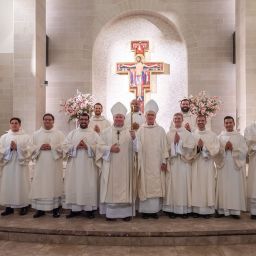
Cutline for featured image: Bishop Edward J. Burns, front center, poses with newly ordained transitional deacons, front from left, Deacons Luiz Guilherme Alves Fernandes, Benjamin Zachary Crocker, Kyle Patrick Fletcher, Ikechukwu Chetachi Iwuji, Roberto Carlos Herrera, and Zak Russell Zapletal following the ordination Mass at St. Elizabeth Ann Seton Catholic Church in Plano on April 25. Also pictured are, back from left, Father Zach Webb, Diocese of Dallas director of seminarians; Father Mark Garrett, diocesan director of the office of Vocations; Father Luca Simbula, Redemptoris Mater Seminary rector; Father Vincent C. Anyama, Holy Trinity Seminary rector; and Father Arthur Unachukwu, diocesan Vicar General, Vicar of Clergy, and Moderator of the Curia. (MICHAEL GRESHAM/The Texas Catholic)