
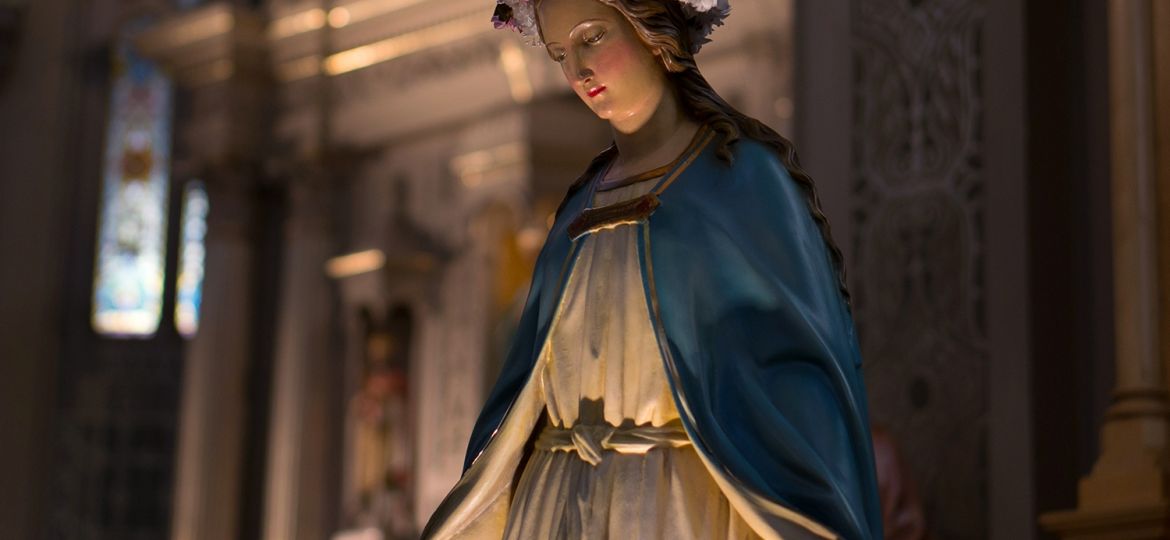
After singing the biblical praises of Mary, the second half of the Hail Mary prayer draws on the Church’s teaching about her singular role in salvation history. Given the simple piety expressed in the prayer and the rosary itself, we easily forget that the title “Mother of God” is the fruit of a tremendous battle for theological orthodoxy fought more than 1,500 years ago.
Jesus is the pivot point of the Hail Mary prayer. In the original Latin text, the prayer consists of two parts, each containing 15 syllables. The first part contains the biblical witness of the Annunciation and Visitation; the second features the doctrinal affirmation of Mary as the Mother of God who prays for us sinners, now and at the hour of our death.
Elizabeth’s words to Mary form the bridge from the Annunciation to the Visitation in the Hail Mary prayer: “Blessed are you among women, and blest is the fruit of your womb” (Lk 1:42). After Mary’s hasty journey to her kinswoman, she, carrying Jesus in her womb-ark, receives an exuberant welcome from Elizabeth and John the Baptist. The unborn babies, Jesus and John, meet for the first time as their mothers embrace. Elizabeth explains what she has felt in her heart and in her womb:
St. Luke gives us the angel Gabriel’s annunciation greeting to Mary as “Chaire, kecharitōmenē” (Lk 1:28). There are thrilling grammatical and theological mysteries packed into these two Greek words.